
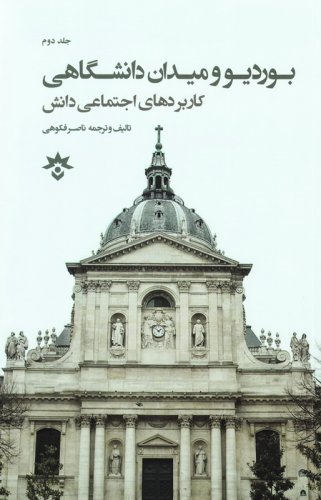
Excerpt from a Book (3): Bourdieu and the Academic Question: Social Applications of Knowledge
Nasser Fakouhi / Institute for Cultural and Social Studies / Two Volumes / 2018

To understand the Bourdieusian approach to knowledge and the university, we must first situate it within the dual framework of the general Western discourse on modernity, power, and knowledge on one hand, and the Bourdieusian problematic of sociology on the other. What we term the “West” here is, drawing from Wallerstein’s thought, a center positioned against a periphery. It encompasses the domains emerged from the industrial-technological revolution and the political revolutions of the 19th and 20th centuries—realms born of capital accumulation and the systematic pillaging of the globe during the long process of world-making, as described by Braudel. Paradoxically, it is this very domain that defines the periphery; thus, “The West and the Rest” emerges, becoming the referenced forms and idealized models that shape the mental maps of social actors worldwide and the entire structure of knowledge and academia within them. In these new socio-political relations, individual and collective bodies—and the relations between them—experience modernity as a trauma stretching from the 19th-century “Belle Époque” to the “era of the camps.” This span, whether at its inception or its terminus in the 20th-century “Holocaust complex,” may be more illusion than reality; nevertheless, it is an illusion that concretizes itself into reality. The Belle Époque sought the symbolic, cognitive, and linguistic reproduction of the Renaissance in religion and art: Protestantism and modern art (anthropocentrism replacing theocentrism), both predicated on the reconstruction of the absolute monarchical state into the nation-state, modeled after the French Revolution.
This movement is fundamentally based on shifting legitimacy from “above” (God) to “below” (the people)—a foundational shift best captured in the accounts of Rosanvallon. The central problematic here is how to align “legitimacy” and “power”—and the nature/culture binary previously posited by philosophers like Hobbes and Rousseau and continued through the ethics/power paradigm in Hegel and Nietzsche—with a “scientific” map of the modern world and the distribution of power at local and global levels, and the relationship between the two, in the Geertzian sense.
The 19th century represented the zenith of Romanticism, whose public mission was the “naturalization” of the “unnatural”—namely, “culture”—to create the “nation.” By doing so, it transferred legitimacy from above via the concept of the “Death of God” to below with the “Birth of the Subject.” A significant portion of this process was achieved by transforming and manipulating the human stance toward “knowledge” and the “university.” In Western history, this manifested as the transmutation of Christian theology into secular science, the primary signifier of which can be seen as early as the 18th century with the Encyclopédie of Rousseau, D’Alembert, and Diderot—a monumental project that presented a scientific counter-model, a product of human labor, in opposition to the “Holy Scriptures.”
Note: This is an AI-generated translation by Gemini, based on an excerpt from the book “Bourdieu and the Academic Question” by Nasser Fakouhi. The original Persian text can be accessed at the following link:
