
Reading the Carpet as a Media Expression of the Multiplicity of Iranian Identity
Nasser Fakouhi

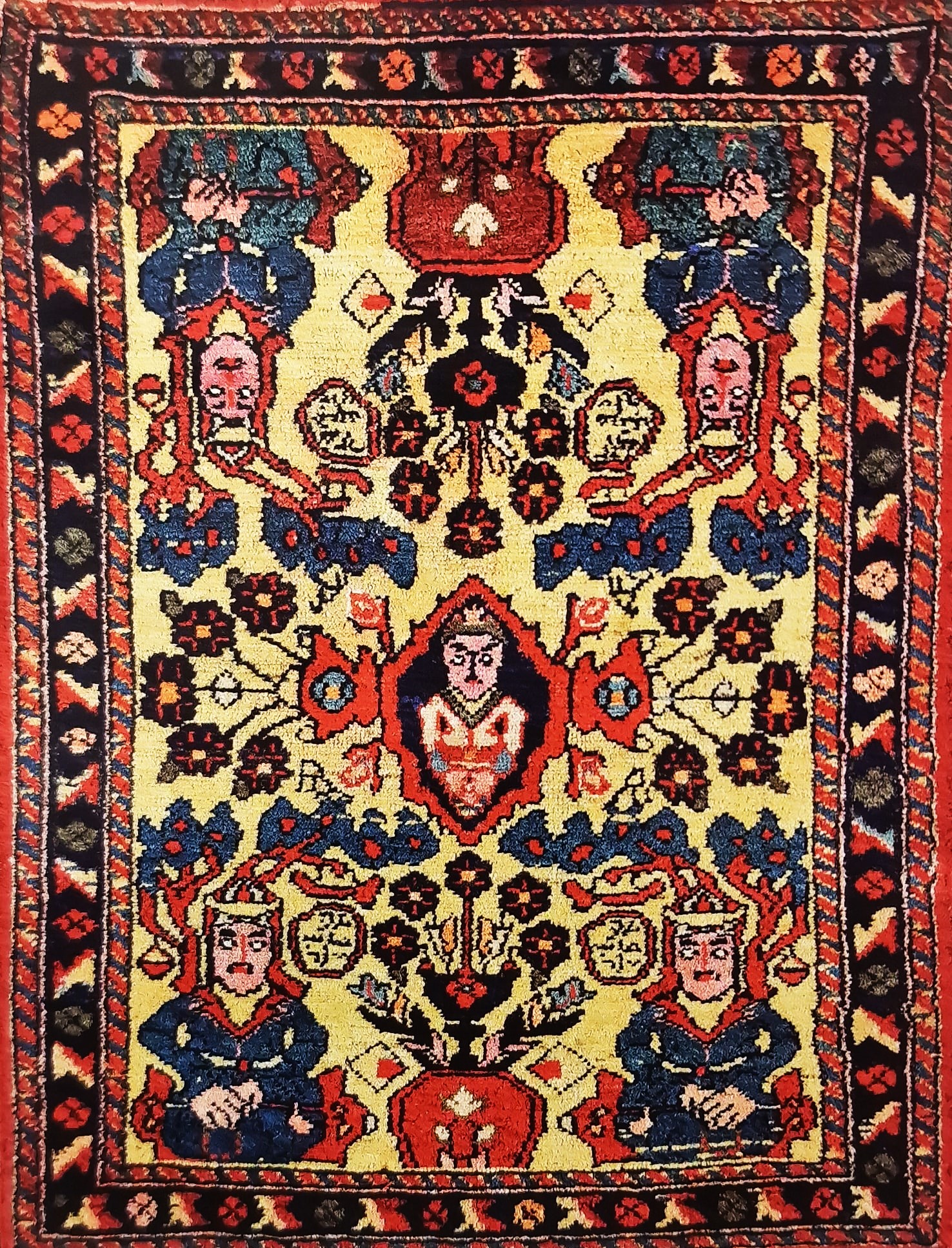
The Iranian civilizational sphere—extending from Afghanistan to the Zagros Mountains, and from the Persian Gulf to the South Caucasus—is often referred to as the “Cultural Iran.” This region represents a shared human heritage that cannot be confined to a single ethnicity, race, or culture at a fixed point in time and space. Rather, it is the product of millennia of convergence among diverse peoples, languages, traditions, arts, and skills. Over centuries, these elements have layered upon one another—or more fittingly, as inspired by the subject of this talk, have become intricately interwoven. This pluralistic civilizational culture should not be confused with a “national culture” framed within the modern nation-state, nor—especially—with the shameful illusions of racial purity and superiority that resurface each time humanity veers toward self-destruction. According to the overwhelming consensus among Iranologists, the peoples who have inhabited this cultural sphere are united not by a written canon but by the primacy of oral and non-written traditions. This is not due to an incapacity for writing or a lack of access to the written word, but because in human history, writing has been only one among many tools for exchanging ideas, preserving memory, and transmitting knowledge. Even today, it does not hold a monopoly in this regard: visual media and other sensory forms—such as tactile, olfactory, gustatory, and auditory expressions—often surpass writing in communicative power.
In Iran as well, this deep-rooted cultural plurality—coupled on the one hand with a desire to preserve and sustain individual and local identities, and on the other with the necessity of having a shared “language” for coexistence and collective cohesion—has led to the emergence and flourishing of certain media forms. These forms, best described as non-verbal or non-linguistic media, have found an extraordinary space for growth and expression. Among them, the most significant systems—centered around the principle of repetition, often interwoven with one another—find one of their most compelling manifestations in the Persian carpet. These systems include:
– Auditory rhythmic systems expressed through sound, music, and poetry
– Visual-kinetic rhythmic systems conveyed through dance and percussive rhythms, both in visual arts and musical structures
– Graphic systems manifested through linear, spatial, and temporal design—evident in architecture, gardens, water networks, pools, relief patterns, decorative objects, and jewelry…
– And finally, the focus of our discussion here: weaving systems—structures composed of interlaced vertical and horizontal paths, with knots that can be understood as semantic knots.
Persian carpets, along with other woven forms such as kilims, chighs, gabbehs, and various types of textiles, brocades, and embroidery, have millennia-old histories. These artifacts not only exhibit a rhythmic pattern of repetition in piercing, stitching, beating, and manipulating colors and threads, but also reflect and articulate specific regional and cultural adaptations.
Thus, a Kashan, Qom, Mashhad, Isfahan, Bakhtiari, or Turkmen carpet, or the tribal kilims, Zagros chighs, nomadic weavings, and Balochi needlework and coin embroidery—all carry their own systems of meaning, modes of expression, and frameworks for cultural interpretation and exchange.
The non-written system in this context possesses a unique complexity, as it integrates nearly all of the previously mentioned systems: from music, graphics, color, sound, and spatial design to architecture, oral mythology, Persian gardens, and narratives that can, depending on the case and sometimes simultaneously, be read and interpreted in linear, circular, or public-horizontal formats.
In this sense, perhaps the closest medium we can compare Persian carpets to is Persian poetry—especially the poetry of Hafez, followed by that of Rumi. The layered and interwoven semantic knots in Hafez’s verses, blending with intricate linguistic, syntactic, and symbolic structures, and the rhythmic and conceptual architectures in Rumi’s poetry, which form deep and complex labyrinths, echo the rich, multidimensional language of Persian carpets.
Here, the degree of semantic complexity in Hafez and the spatial-musical (auditory) dynamism in Rumi can be compared to the tension and interweaving of knots and threads in a Persian carpet. The greater the complexity, the more open the piece becomes to interpretation; and the more interpretable it becomes, the more ambiguity it carries—thus generating increasingly intricate processes of encoding and decoding. This, in turn, allows both form and meaning to persist across broader, deeper spans of space and time.
In this sense, the ornate richness of a densely patterned carpet—often a visual reproduction of the Persian garden—on one hand, and the monochromatic gabbeh—a minimal echo of mountain pastures—on the other, both belong to the same spectrum of meaning and form. This can be likened, for instance, to the endless variation of color and composition in a painting by Seraphine de Senlis, Henri Rousseau, or even Jackson Pollock, contrasted with the focused chromatic unity and minimalism of Yves Klein’s Blue, Mark Rothko’s Oranges and Yellows, or Kazimir Malevich’s “White on White”. Providing further examples from other art forms is certainly possible, but perhaps unnecessary here, since the structural logic behind dialogic media exchange among Iranian cultures—and the generations of Iranians who have maintained their connection to space, and especially to land, through the carpet—is already illustrative enough. The literary expression “the carpet of nature” is but one example that reflects this deep-seated cultural significance, where meaning is built through layered interpretation and form. Thus, Iranian culture allows for Iranian identities to be expressed in endlessly intricate formal and semantic configurations, as well as in radically simplified ones. This duality ensures the preservation of all forms of identity—not by relying on a single mediating identity (such as a shared language)—but rather by emphasizing a broad spectrum of layered and interpretable artistic systems. In this way, aesthetic multiplicity becomes the primary mechanism for cultural cohesion. In this way, Iranians are able both to remain themselves and to transform into the Other—stretching their identity from Yazd to Kerman, from Kerman to Isfahan, from there to Sanandaj, and further to Tabriz, Qom, Kashan, Mashhad, Ardabil, Na’in, the Bakhtiari mountains, the plains of Azerbaijan, the foothills of the Zagros, the desert margins, the green and miraculous oases, and the shores of the northern and southern seas. In doing so, they elevate the carpet, through rituals such as the Qālī-shuyān of Mashhad-e Ardehal, to a level of sacredness comparable perhaps only to that found in Catholicism and the Passion rituals of Christ.
The carpet holds an identity-defining role for Iranians because it not only reflects the identity of its weaver and its user but also carries a destiny that has likely spanned decades or even centuries, embodying the memories of successive families and generations—and projecting the future fate of these families. Beyond this, the carpet serves as a language for dialogue among diverse cultures that express themselves through various styles, patterns, and colors. Through this medium, cultures can be compared, exchanged, and transformed—turning one culture into another and vice versa.
Finally, for Iranians, the carpet can act like a transparent and wondrous veil—much like in Akira Kurosawa’s film “Dreams” (1990), where one might immerse themselves in a Van Gogh painting or interpret it like the poetry of Hafez, joyfully dancing to the music of Rumi through its metaphorical alleys and gardens. The symbolism of the carpet makes possible the miracle of seeing oneself as a flock of birds perched on the branches of a tree, watching each other, then taking flight and exchanging places on the trees of this garden. Through the repetition of colors, lines, curves, circles, rhythms, and the ecstatic intoxication of Sufi mysticism, one experiences a unique spiritual harmony.
—Summary of Nasser Fakouhi’s lecture at the “Farshvareh” conference, Iran Carpet Museum, January 3, 2017 (14 Dey 1395)
This text is an AI-generated translation of a Persian article originally published on Nasser Fakouhi’s website (nasserfakouhi.com). The original article is available at the following link:
