

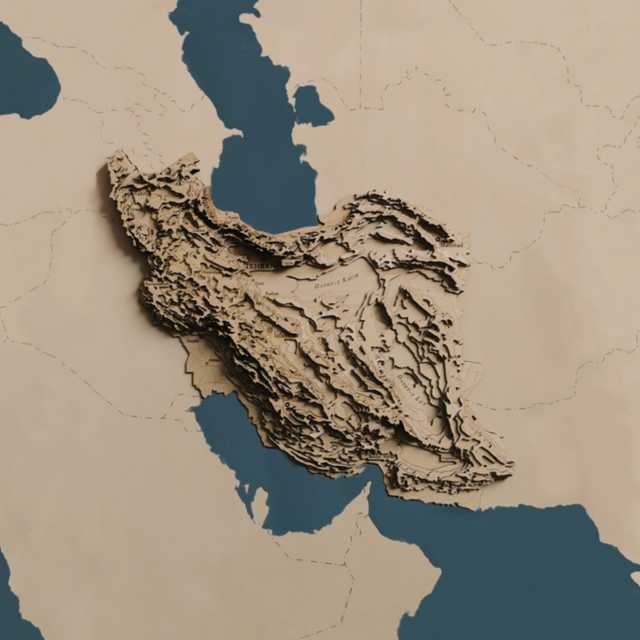
This note is being written at a time when all major media outlets are speaking of an imminent war expected to occur this very weekend (Saturday and Sunday, the first and second of Esfand 1404, corresponding to February 20–۲۱, ۲۰۲۶). The United States has deployed all the equipment required for a full-scale and relatively prolonged war (lasting several weeks or even months), while the Islamic Republic has declared its complete readiness to confront the United States and, of course, Israel. Alongside this, a media and psychological war has long been underway across internet networks and continues unabated.
What is written here is not a prediction. In fact, for numerous political, geopolitical, and actor-related reasons involved in these tensions, we do not believe that even a relatively accurate forecast is possible, nor do we consider such predictions to be inherently useful. Rather, following two of our previous notes (1), this text seeks to provide an analysis of the current political situation and the possible and probable trajectories in the coming months.
In our view, the importance of such an analysis lies in its potential—however limited—to contribute to solidarity and cohesion among Iranians, to reduce collective illusions, and to increase awareness regarding the future fate of our country and culture. Accordingly, we are in no way seeking to defend or attack any particular group or set of beliefs. Especially over recent months and years, we have consistently emphasized that what we are witnessing is the sacrifice of culture and civilization at the hands of actors pursuing power, wealth, and privilege.
First Remarks
We begin by stating our underlying assumptions. Powers and states must be analytically distinguished from cultures and civilizations, both conceptually and practically. Power—more precisely, political power—is the outcome of actions and reactions unfolding over time and across innumerable spaces, emerging through the historical processes of a cultural and civilizational field, its history, and its global and regional positioning at a given time–space configuration.
In other words, every power and governing system arises from the culture and civilization of the people inhabiting a given territory and the world in which it has existed. However, this does not mean that once power emerges, that time–space configuration continues unchanged. It is precisely for this reason that we speak of historical transformation. Likewise, the legitimacy of political power and its capacity to manage a social system cannot rest solely on its legitimacy at the moment of its emergence; rather, it is the product of the totality of its actions over time. Political power can thus lose its legitimacy partially or even entirely.
The degree of erosion of legitimacy—whether in democratic or even non-democratic contexts—can be assessed through various criteria, but above all through internal social calm and external interaction. These two conditions are mutually dependent: without internal stability, external interaction is impossible, and vice versa. From this perspective, political power in Iran, both before and after the Revolution, has reached a stage of severe legitimacy erosion during distinct historical periods. Prior to the Islamic Republic, this erosion reached its peak from the early 1970s and culminated in the 1979 Revolution. In the current system, erosion began to intensify from the early 2010s and is now approaching its apex.
This apex may prove devastating and extremely costly, manifesting either as a bottom-up socio-political transformation (revolution, widespread uprising, civil war, or coup), as foreign military intervention (such as the present threat), or as a combination of both.
What we have observed over at least the past year—together with the ineffectiveness of the reasoned warnings issued by the overwhelming majority of intellectuals, academics, and even concerned specialists familiar with Iranian and global historical experiences and crisis management—suggests that, given the trajectory of events, the possibility of a non-violent exit from the current situation is, if not impossible, at least extremely low.
Internally, the inability of political power to respond to popular needs—except through astonishing levels of violence—combined with the escalating demands of society, has effectively closed the horizon of a return to any “normal situation,” at least in the short and medium term. The pervasive sense of social suspension and uncertainty bears witness to this reality.
Externally, tensions with a broad group of global powers (the United States, Europe, and the West more generally) have reached an exceptionally high and critical level. These powers view the outcomes of Iran’s foreign policy with suspicion, fearing the possibility of short- or long-term military and security threats emanating from Iran, as well as the absence of prospects for a comprehensive agreement. At the same time, Iran’s decisive turn toward the East (Russia and China) is perceived by these powers as a definitive withdrawal from the post–World War II global order—an outcome highly unlikely to occur outside the context of a Third World War. It is our view that even Russia and China themselves are well aware of this reality and are extremely unlikely to contemplate engaging in a global war over Iran’s fate.
Beyond the external dimension, most analysts agree that the continuation of recent domestic policies—namely, the combination of neoliberal capitalism, economic corruption, authoritarianism, and political repression and violence—makes political, social, and economic stability in Iran impossible, not only in the short term but even in the long run. Consequently, such instability would also extend to the region, a prospect unacceptable to Iran’s powerful neighbors and to global powers alike.
The Near-Inevitability of External Violence
Given the current situation and the considerations outlined above, the likelihood of a military and aggressive attack by the United States and Israel is very high. These two countries pursue different objectives. Setting aside secondary issues, Israel’s overarching goal is the destruction—or even the fragmentation—of Iran, along with the instigation of severe internal tension or even civil war, thereby ensuring Iran’s long-term weakening and, ideally from the perspective of Netanyahu’s supporters, the weakening of the entire region. This would allow extremist forces under his leadership to advance the project of a “Greater Israel” and position themselves as the primary and exclusive representatives of U.S. and European interests in the Middle East.
It is evident that neither the United States nor Russia and China desire such a scenario. Their preference is for power in the region to be distributed among multiple centers (the Gulf Arab states, Turkey, Iran, and Pakistan, alongside Israel). Such a balance would produce far more stable borders and international positions for both major powers and regional states alike, as opposed to rebellion, chaos, destruction, and fragmentation—conditions that create uncontrollable, highly dangerous, and explosive situations.
Nevertheless, the possibility of preventing external violence is not entirely nonexistent. Even if war were to begin, there would still be room, in the days or weeks following its onset, for negotiations to continue and for an agreement to be reached—provided both sides demonstrate flexibility. However, the likelihood of such flexibility emerging prior to the outbreak of war appears minimal. Thus, in the event of war, one can only hope that it will end as swiftly as possible.
It is clear that in any externally imposed war, the primary objective of all Iranians must first be to prevent it and, failing that, to defend the territorial integrity and existence of their country. Without a country, neither governance nor the construction of a future upon ruins can be rationally conceived. Accordingly, the most effective defense against the clearly identifiable opportunism of foreign actors lies, in our view, in striving for the ascendancy of reason and rational actors, changing policies that have rendered external interaction impossible, and preventing the continuation of policies that further alienate people from political power and from one another.
The Relative Inevitability of Internal Violence
The greater the escalation of tensions, mistrust, social polarization, and fractures—particularly ethnic, ideological, religious, and political ones—the closer Israel’s strategy comes to practical realization. Conversely, the more political, social, and economic stability becomes achievable, the more acceptable the situation becomes for regional neighbors and global powers alike.
Had internal political violence not reached such extremes, had legitimacy not eroded to this extent, had domestic alternatives not been so thoroughly marginalized, and had extremist approaches not been so disproportionately prioritized, it might have been possible to mitigate internal violence and its destructive consequences. Yet the claim that all internal resources for achieving a horizon of social stability have been exhausted is, in our view, incorrect.
Perspectives that interpret both internal and external relations in purely black-and-white terms can lead only to destruction and to outcomes far worse than those we currently face. History demonstrates that even under the most catastrophic imaginable conditions—whether external or internal wars—hope for peace, reconciliation, and the avoidance of further destructive violence can still exist.
Violence and war are absolute evils. Beating the drums of war—seeking to dehumanize and annihilate all those who stand before us—or beating the drums of revolution in a manner that refuses to accept the “other” in any form or dimension, amounts to submission to absolute violence, whether imposed from above or arising from below. What we have stated neither diminishes responsibility for crimes committed nor suggests that such crimes should or can be forgotten or ignored. The issue is that we must not, insofar as possible, build our future upon violence—external or internal—or upon revenge.
History has shown that violent resentment and vengeance yield nothing but a terrifying descent into destruction and regression. Today, as yesterday and tomorrow, our position remains a defense of freedom of expression for all opponents (except opponents of freedom itself), justice, and independence—without the need for, or legitimacy of, any form of violence. Violence produces nothing but more violence and the erosion of those very ideals.
۱ Esfand 1404 (February 20, 2026)
A Short Reflection on Iran’s January 2026 Political Violence: Toward a Nonviolent Approach / Nasser Fakouhi
A Short Reflection on Iran’s January 2026 Political Violence: Toward a Nonviolent Approach
Forty Days Later: Reassessing a Catastrophe and Its Consequences / Nasser Fakouhi
Forty Days Later: Reassessing a Catastrophe and Its Consequences
This is an AI-generated translation of a note by Nasser Fakouhi, available at the following address:
