
Duane Hanson (1925–۱۹۹۵) / Supermarket Lady (1971)
Nasser Fakouhi

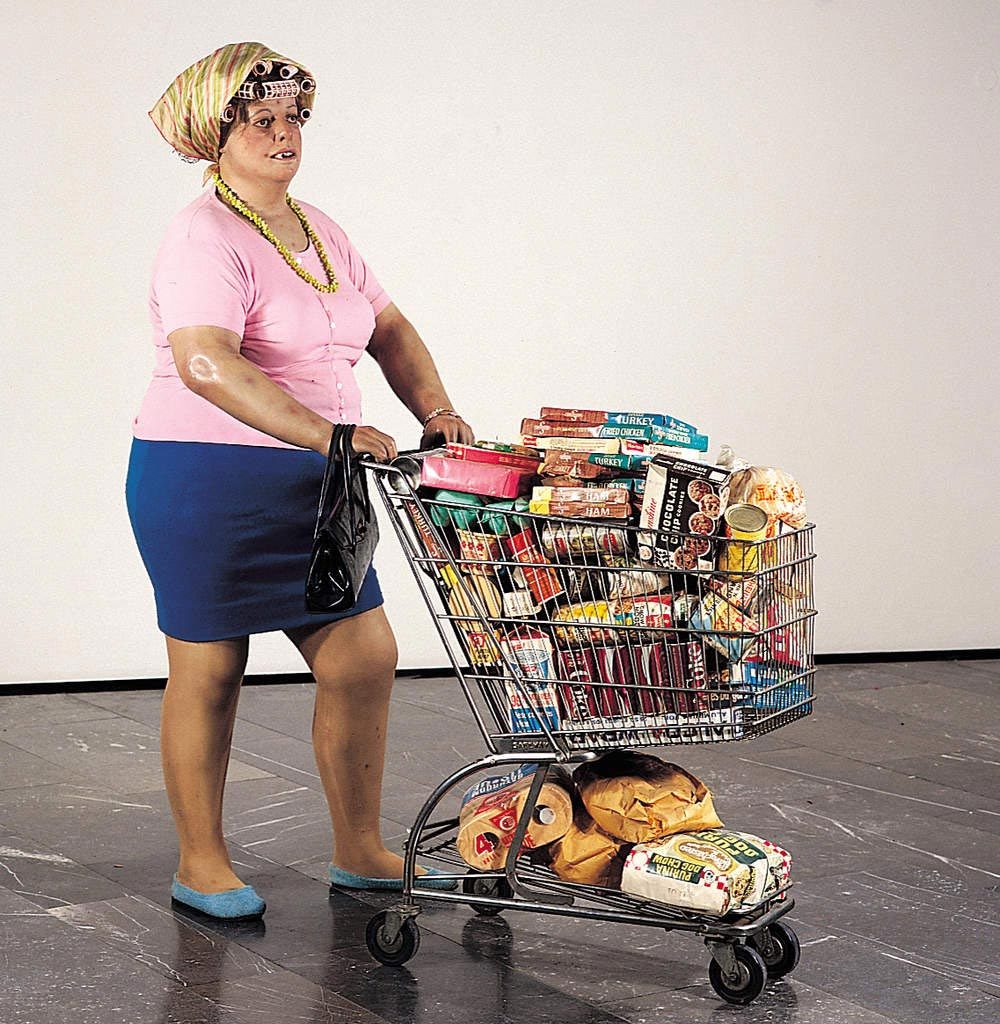
Hyperrealist painting—and subsequently hyperrealist sculpture (distinct from the long-standing, and even ancient, tradition of idealized figurativism)—first emerged in the United States from the 1960s onward. This was precisely the period when abstract art and the move away from figurativism were at their peak. Significantly, this era also witnessed the rise of social critique as an active force—one that would fuel multiple revolutions within American society and, subsequently, on a global scale: from feminist critique to critiques of the market and consumerism; from opposition to war-oriented policies (Vietnam and post-colonial conflicts) to critiques of the Holocaust; and from critiques of the market to those of everyday life and the “politics of spectacle,” which reached their height in Europe through thinkers such as Guy Debord, Henri Lefebvre, and Jean Baudrillard, flourishing particularly in the 1970s.
Yet hyperrealism—by economizing on traditional drawing techniques and turning directly toward reality as its point of departure—approached photography in painting and the actual human body in sculpture. In the latter case, it initially employed plaster casting and later increasingly sophisticated materials in order to achieve a resemblance to reality so exact that it became virtually indistinguishable from living or external reality itself. Rather than signaling a desire to return to figurativism, hyperrealism thus revealed the same impulse that led artists such as Andy Warhol and Roy Lichtenstein to appropriate consumer goods, everyday objects, and images from popular magazines and tabloids as the raw material for the creation of their distinctive artistic practices.
In painting, however, artists such as Duane Hanson adopted a critical stance toward an early tendency within hyperrealist art to foreground the “American way of life”—that is, what in the United States was presented as material abundance and freedom from concern in matters of food, security, and shelter, as well as the enjoyment of freedom of expression and, more broadly, a particular mode of relating to the outside world. In Supermarket Lady, a work that belongs to a much larger body of Hanson’s sculptures devoted to the everyday lives of ordinary people (rendered at life scale), the artist deliberately presents banality in its “ugliest”—or perhaps more accurately, its most “conventional”—form. This approach recalls what can be observed in the work of the British photographer Martin Parr.
In Supermarket Lady, we are confronted with a woman whose body is excessively obese, to the point of appearing pathological; whose hair is set in curlers and covered with a headscarf; whose makeup is heavy yet entirely commonplace; whose apparent health seems credible only insofar as it is sustained by extreme consumerism; and whose shopping cart is overflowing with goods whose manner, timing, and mode of consumption remain entirely unknown.
With a disheveled appearance, tasteless clothing, and a form of everyday life that is almost “repellent,” this figure embodies a banality that few viewers have the courage to contemplate—or to recognize as a possible reflection of themselves in the mirror. The museum visitor’s direct confrontation with this character provokes a sense of inner revolt. It should nevertheless be noted that alongside Hanson, there are other hyperrealist artists who, while also engaging with everyday life, have managed to elevate it and to render it in its most beautiful aspects. The works of John d’Andrea—among them his Nudes and the striking Mother and Child—as well as George Segal with his plaster figures, or Carole A. Feuerman with her female swimmers, are only some of the examples one encounters within hyperrealism.
Facing these bodies—so close to the human form that they cannot be separated from one’s own body, and moreover occupying the same physical space as the viewer—one is nonetheless confronted with “dead” or inanimate forms. These forms, paradoxically, are far closer to reality than those produced by the tradition of figurativism and the materials it conventionally employed (stone in sculpture, oil paint on canvas). Indeed, they appear almost indistinguishable from reality itself, and it is precisely for this reason that they generate in the viewer a simultaneous feeling of aesthetic pleasure and deep unease. This ambivalence is echoed in the slogan of the exhibition currently on view (December 2022) at the Musée Maillol in Paris. Upon leaving the exhibition, one can accept a return to the real world with a mixture of enjoyment and anxiety. Inspired by Magritte’s famous phrase—“This is not a pipe!”—the exhibition’s entrance slogan declares: “This is not a body!”
This text is an AI-assisted translation of a note, the original of which is available at the link below:
