
Art as Resistance: Feminine Strategies for Visibility and Presence in Iran
Nasser Fakouhi's speech at the Iranian Artists Forum, Tehran 2017

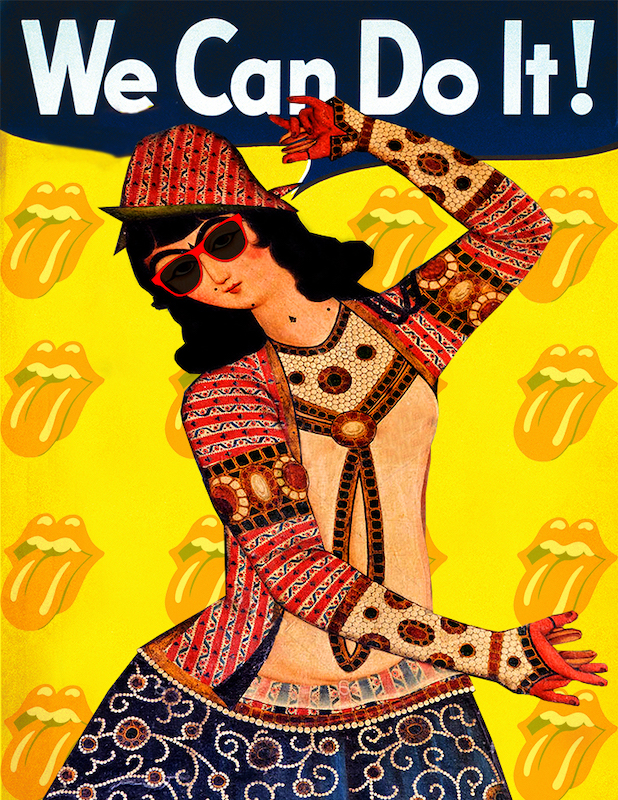
Speaking in this venue—the Iranian Artists’ Forum—in the role of an anthropologist and sociologist requires me to ground my discussion more deeply within the realm of art and to approach my two main topics from the perspective of the social sciences. The first topic is art, and more specifically, painting. In my view, painting in Iran is an art form that lends itself exceptionally well to analytical examination in relation to gender within a structural framework. In this context, I wish to focus my discussion on artistic strategy as a tool of resistance and struggle employed by women under subjugation within a patriarchal and misogynistic societal structure.
First, the question arises: why and through what mechanisms can painting function as part of a feminine strategy? This is a question that remains relatively recent even on a global scale, and vastly more so in Iranian society. Unlike music, painting does not have a deep historical precedence in Iran. The utilization of artistic tools in resistance and struggle is not necessarily tied to the absence of an inherent artistic essence or the widespread practice of a particular art; that is, these two aspects are not in contradiction. I emphasize this point to prevent any misinterpretation of my argument, allowing us to distinguish the historical trajectory of an art form from the mechanisms of its social appropriation. Therefore, on one side, we have the dimension of aesthetics, and on the other, the strategy of resistance and struggle against the violent, patriarchal, and misogynistic pressures that weigh upon half of the human population in our society.
The second topic concerns the general approach of social presence, which is not necessarily tied to art. Here, I will focus my discussion on two terms, striving to demonstrate their differences and to elucidate their relationship with painting: one is “becoming visible” (or “visibility”) for women, and the other is “presence,” exploring how these two relate and how this process must and can extend beyond painting. A woman who is incapable of “seeing” cannot project anything through an artistic system fundamentally defined by the “gaze,” such as painting or photography; conversely, the woman herself remains unseen, and this relationship continues in a cyclical manner.
The other concept is “presence.” I will address both subjects from the perspective of the social sphere: the social visibility of women and their social presence. I will argue that, historically, women have always been present in the social order in various feminine ways. However, what demands attention is not mere presence, but rather the form of that presence and its underlying mechanisms. Conversely, “visibility” has either been absent or extremely minimal for women. Upon exiting the sphere we designate as childhood—that is, the child’s role—women entered a realm of non-visibility (invisibility). In the social system of Iran, we still witness puberty and the age of marriage for women being set at nine years old. Beyond historical factors tied to its origins, the rationale behind this lies in the fact that, at this threshold, a girl departs from childhood; her physical and bodily form is no longer infantile, and she is defined no longer in the position of a “child,” but in the position of a “woman.”
From the distant past, human societies have maintained approaches wherein a child—whose image and mentality are gender-neutral—is permitted visibility, whereas a woman is denied such permission. There is extensive literature on this in anthropology. As soon as a woman enters the position of “womanhood,” she must be relegated to the domestic sphere; she must be concealed behind various forms of covering whose primary mechanism is, in truth, the eradication of visibility and the “individuation of the female subject.” I have previously addressed the fact that the dress code mandated for women in Iran is everything except what it is ostensibly intended to be. This system not only fails to eliminate visibility, but actually multiplies it—defeating its initial purpose. Of course, we must distinguish this from the concept of “veiling” (or modesty).
The purpose of veiling is to curtail or eradicate “visibility” or “presence.” In highly patriarchal and intensely misogynistic societies—such as certain Arab communities in North Africa, the Middle East, or even specific southern regions of our own country—clothing functions as total covering; essentially, it transforms femininity into an invisible object or “objectifies” the woman by reducing her to her attire. In this sense, there is no distinction between subject A and subject B; all that is visible is a physical body beneath a shroud. A prime example of this type of covering is observed in Afghanistan. Afghan women in their traditional blue garments are not seen as individuals; rather, they are invisible bodies compelled to enter the social system, covered and dispatched into society. In reality, this is a form of “packaging.”
In Iran over recent decades, where dress codes have been enforced with increasing severity, women have not acquiesced to becoming indistinguishable packages of bodily matter. Instead, through feminine approaches, they have labored so extensively upon these garments that identity has been entirely reconstructed. The original intention was for clothing to exert such influence over a woman as to render her invisible. Yet, the Iranian woman, employing feminine strategies, incorporated the garment into her own body, rendered the clothing invisible, and made herself visible. Comprehending this phenomenon may appear somewhat difficult even for intellectuals, and it is naturally quite impossible for the general public. When we say clothing has become the body, it means the garment is fused with the physical form; in our country, this has occurred to a far greater extent than what we witness in the United States or Europe. There, clothing serves as bodily ornamentation rather than a part of the body itself. One might assume these two are identical, but they are not. In the West, the function of clothing is bodily ornamentation or homogenization—such as a nurse’s uniform or garments designed for interactive contexts—alongside nudity, which is itself a system of dress. The assertion that nudity constitutes a system of dress is a complex notion that is not easily grasped. Nudity can function as covering, and covering can function as nudity. It is entirely possible to have nudity devoid of eroticism, and covering suffused with eroticism. In his work, Bourdieu recounts a well-known anecdote cited by a famous author: a female art model posed nude in a studio for painting students, who drew her. Suddenly, through the window, the woman noticed the gaze of a man in the distance and, before the astonished eyes of the students, quickly stood up, ran toward her clothes, and hastily covered her body. Bourdieu analyzes this action, arguing the fundamental difference between an aesthetic gaze and a patriarchal gaze. According to him, we confront two distinct forms of looking and being seen: inside the studio, where the woman sat before the students, eroticism was absent, whereas the external gaze was thoroughly eroticized. This analysis applies equally to clothing and its absence.
The history of gender-based relations—the relationship between men and women—is ancient, spanning both Iran and the global context. According to Françoise Héritier, formerly head of the Laboratory of Social Anthropology at the Collège de France, this differential relation between men and women, and male domination over women, dates back to the very dawn of humanization—approximately four million years ago. One of our points of contention as anthropologists with feminists is that the latter believe in a mythical era of “matriarchy,” whereas such an epoch has never existed in any human society. What did exist was “matrilineality” or “mother-lineage,” meaning the tracing of descent through the mother. How do Françoise Héritier and others explain male dominance over women, a phenomenon absent from biological systems? The explanation lies in an initial division of labor—or a cultural deviation.
As Bourdieu observes, this occurs within the structure of male or masculine domination. This cultural deviation does not stand in contradiction to biological differences, which exist across biological systems among animals as well. However, this has no bearing on male domination. The bedrock of male domination resides in the cultural division of labor, linked to human occupations and roles in the reproduction of the economic system. The man becomes the hunter, while the woman, largely for biological reasons, must remain stationary or experience constrained mobility. The woman is compelled to restrain herself because she must nurture her offspring. Anthropologists have also debated the anatomical system. With the emergence of Homo erectus (upright man), hands were freed, and these hands were utilized to protect the infant; it is the female who shoulders this responsibility far more than the male. If one observes a moving monkey, the infant clings to the mother, not the mother to the infant, because the mother utilizes all four limbs for locomotion. In humans, however, it is the mother who cradles the child. The mother becomes localized in space, while the male hunter becomes mobile. The male hunter transforms into the warrior; the hunting weapon morphs into the weapon of war. Violence is produced and reproduced as the very structure of masculinity—a violence that subsequently permeates every dimension of human life. Right now, the sound of football spectators shouting outside this building is an expression of masculine violence, even if women are present among them, because women do not ordinarily shout in this manner. This masculine violence crosses the windows and penetrates this room, where women constitute the majority of those present.
The fact that the majority of attendees here are women, while the majority of those shouting outside are men, is neither coincidental nor groundless. Having spent two decades in academia, I can state that a new division of labor has been unfolding in our country for years: men pursue money, while women pursue intellect. Consequently, we observe men who equate success with acquiring wealth, and women who define success in terms of self-actualization. This is a distinctly feminine approach: let men work, earn money, and console themselves with the belief that they hold governance, while at the exact time they leave for work in the morning, we [women] visit art galleries, attend the Iranian Artists’ Forum, participate in diverse meetings, or paint ourselves. In ancient Greece, a similar dynamic unfolded, albeit through the presence of men. Slaves labored from morning onward, while free men either exercised or attended philosophy classes. According to the Greeks, labor was unbecoming of a free man and suited only for slaves. Men who wished to emulate women were compelled to resemble them physically as well; thus, Greek athletes shaved their bodies. Similarly, just as women’s entry into stadiums is barred in today’s Iran, exclusion operated in Greece—albeit for a different reason, which was that the men were completely naked. In effect, hairlessness, feminization, and eroticized nudity formed a dialectical relationship that has been extensively debated.
Feminine strategies are not necessarily conscious, nor does the feminine character of these strategies automatically guarantee an improvement in women’s conditions. We constantly operate within systems where solutions to our problems appear deceptively simple, when they are anything but. In Zoroastrian texts, we encounter a figure named the “Great Patiyareh,” the daughter of Ahriman (the Evil Spirit). When Ahriman swoons, his daughter kisses his forehead and awakens him. This serves as the archetype of feminine malice, observable in the concept of original sin within other religious texts, where the woman hands the apple to the man on behalf of the serpent. This raises the question: why did such an idea crystallize within religious belief systems?
One answer is that this represents the reaction of men who have fallen victim to feminine strategies. I have often remarked that every man’s misfortune is that he exists as an extension of a woman. Men can direct insults at all women, with the sole exception of their mothers. Numerous anthropologists and psychoanalysts, such as Françoise Héritier, have conducted extensive research on this phenomenon; men have never been able to banish this complex. Consequently, we encounter expressions in literature, art, and vernacular language stating that “all women are prostitutes, except my mother!” We recognize this as the masculine structure of violence.
The masculine structure of violence dismantles visibility and reduces presence to a bare minimum. Yet, women maintain a presence through men, for the lucid reason that men are their offspring. Throughout history, we observe the powerful roles of women in political structures. However, following the advent of modernity—which, in my view, has not fully materialized in Iran—women entered the socio-economic system largely out of necessity. The initial demands of a woman entering the industrial era were entirely economic; she sought equal rights with men. Even a portion of these demands remained distinctively feminine: the woman desired the opportunity to simultaneously fulfill her maternal responsibilities.
These demands subsequently escalated, culminating in today’s landscape where women seek absolute equality and structural transformation across the entire fabric of society. Women no longer settle for mere presence; rather, they demand active presence, rejecting passive and indirect participation. Indirect presence denotes a feminine presence within the patriarchal order mediated through male representatives—sons, husbands, or brothers. Direct presence, however, signifies a woman stepping into the shoes of her son, husband, or brother. Within the system, she transforms into a cognizant female subject whose identity is no longer defined in relation to a man, but is recognized and articulated on her own terms.
Naturally, a patriarchal system forged over millions of years will not easily accommodate this transformation. According to Bourdieu, women today are enduring retribution from men who have suffered defeat within the “home.” Following industrialization, men were compelled by necessity to assume novel domestic roles. The man is no longer the absolute master of the house, nor the woman his servant. Today, domestic labor by men has been normalized; it is no longer astonishing for a wife to tell her husband, “Stay home tonight and care for our child so I can go to the Iranian Artists’ Forum.” Fifty years ago, such a scenario would have seemed inconceivable, and had a woman attempted it, she would have faced censure from other women as well.
The domain of painting in Iran is a nascent phenomenon. Its roots trace back to the absence of “anthropomorphic representation” in Zoroastrianism and subsequently Islam. In these religions, the Divine is formless, and depicting His likeness is forbidden. Consequently, Iranian cultural systems—both pre-Islamic and post-Islamic—ventured into non-figurative domains. This explains why Iranian graphics are exceptionally robust: graphics are formless in the mimetic sense; they do not reproduce organic life. The forms in this art are abstract, disconnected from living organisms. If one examines Iranian architecture, carpet weaving, spatial synthesis, and poetry, this reality becomes evident. The world has produced no poet comparable to Rumi; the ambiguity of Persian poetry constitutes those very graphic layers of meaning that construct the architecture and significance of the verse.
Even when Iranians ventured into the realm of painting, they birthed miniature art, wherein human figures are miniaturized, perspective is absent, and other distinct features prevail that we cannot fully explore here. Under such conditions, art—without sacrificing its aesthetic dimensions—transforms into a novel instrument of presence. I wish to draw attention to the documentary Taraneh (The Lark) by Mohammad-Hassan Damanzan. The film portrays several rural women who had loved music since childhood yet faced parental opposition. Secretly, these women taught themselves to play instruments and sing. We know that prior to the Constitutional Revolution, women in Iranian families clandestinely engaged in music and song.
The fundamental question is this: do women gravitate toward art driven by innate taste, inclination, and talent, or by strategy? My answer is: by both. These motivations are inseparable. A female musician or vocalist hears music and song emerging directly from her own body. Thus, through artistic production, she reproduces and validates herself, expanding her presence across a relatively expansive radius. For this very reason, rigid traditionalists in past eras insisted that when a woman spoke, she should place her finger in her mouth to muffle her voice; in that paradigm, the woman was no longer a subject, and that voice was no longer her own.
Through painting, a woman constructs “visibility” and thereby penetrates the social system. A woman’s painting is hung upon a wall; that wall becomes feminized, and within a cyclical and feminine relationship, it assaults patriarchal systems. This struggle is not a conflict between women and men, but rather a clash between two concepts. One concept is biological: the life and vitality of which women have been the bearers over millions of years. The other concept is death and pain—death and pain disconnected from life, bound instead to patriarchal structures, which we identify as a cultural and biological deviation.
Consider cooking. Cooking has fundamentally challenged the biological condition of human beings, for in our raw biological state, we cannot consume many substances. We are not carnivorous in the raw sense; thus, we must cook meat and dismantle its primary composition. This constitutes a biological and cultural deviation. For millions of years, women have been compelled—not necessarily by their own volition, but by the imperatives of life itself—to act as bearers of those dimensions of the human spirit that tether humanity to nature.
Perhaps it is unexpected for an anthropologist to speak against humanity itself. Yet, I must state that since the fundamental trajectory of life has entailed the extinction of species—with over eighty percent of species having vanished—the hypothetical erasure of the human species is by no means inconceivable. There are ample grounds for this vital warning. Over its four-million-year presence in the biosphere, and particularly across the past four millennia, humanity has degraded nature to a degree unprecedented in the history of life. Humanity is a perilous species, threatening to nature, other species, and ultimately to itself. I will set aside the numerous slaughterhouses constructed to breed animal species for consumption; I speak of human-on-human destruction. In the twentieth century alone, humanity slaughtered three hundred million of its own kind. In biological history, such intra-species carnage is entirely without precedent. Therefore, even from an ethical standpoint and for the salvation of nature, one might well decree a collective human suicide.
Yet, from the perspective of an anthropologist, I wish to speak of hope. At present, not only in Iran but across the entire globe, the sole remaining chance for human survival lies in the feminization of the world. Roughly a decade ago, I conducted an extensive dialogue titled “The Feminization of the World: An Alternative to Masculine Violence.” There, I noted that the feminization of the world does not signify the marginalization of one sex in favor of another, but rather the return of humanity to the position ordained for it by biology within its natural cycles—namely, a creature defined by life rather than death, a being that discovers pleasure in pleasure rather than in pain.
This text is an AI-generated translation, and the original text can be found at the following link:
