
A Brief Analysis of Ingmar Bergman’s Shame
Nasser Fakouhi

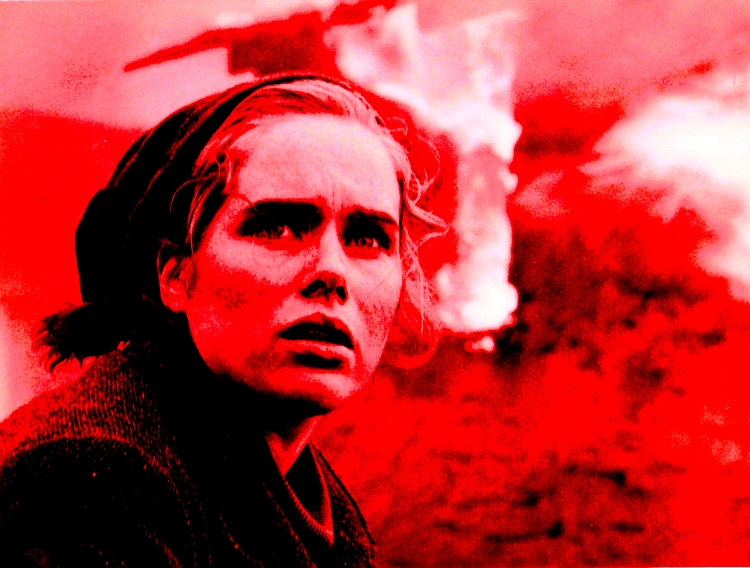
In “Shame”, we witness life unfolding through the lens of a “war,” albeit a fictional war that creates a monstrous “nowhere.” The film’s setting is a “non-place” in a “non-time,” depicting not a direct reality of war but rather a representation of reality—in the Baudrillardian sense of the term. The erasure of identities occurs through the destabilization of space and time: without recognizing the actors and the language, one could not tell that the film apparently takes place in Sweden. The director deliberately avoids assigning a specific identity or fixed temporal and spatial markers, aiming instead for a sense of universality. The film is set on the Faroe Islands (Bergman’s retreat), featuring Liv Ullmann, Bergman’s wife, which suggests a personal and intimate narrative closely connected to the director himself. However, the story can be seen as the narrative of “anyone” in “anywhere” and “anytime.” The devastation portrayed could fall upon any person, at any place, and any time. This is the heavy Bergmanian tragedy of the film. Spaces and times are deliberately made timeless and placeless through objects, sets, and scenes: the event could have taken place ten, twenty, or fifty years ago. A notable detail is the absence of linguistic signs (such as written text); the soldiers’ weapons and uniforms lack any identifying marks, symbolizing a state of anonymity—or perhaps “any-identity.” These soldiers could belong to any army or none at all. The tanks and armored vehicles appear monstrous and surreal, with sharp, unbelievable edges, deliberately blending banality and exceptionality. Usually, weapons bear political symbols, representing a power with its own signs; here, however, the absence of signs itself signifies a form of universality. War breaks out over people who do not know why, turning them into monsters who feel nothing but “shame” toward themselves, their dreams, and their existence. For them, even beautiful dreams cease to exist—dreams transform into nightmares, and their aesthetic skills become mere survival tactics amid a merciless and senseless cruelty that pervades everywhere. Death is omnipresent, like a sea of swollen corpses of fallen soldiers, which one must pass by indifferently to make way for the “self.” Bergman’s narrative, expressed in his unique philosophical and poetic language, becomes one of the most powerful anti-war manifestos.
This is an AI-generated translation of a note by Nasser Fakouhi(16-07-2025), the original of which can be accessed at the following link:
