
A Brief Analysis of Ettore Scola’s Ugly, Dirty and Bad (1976)
Nasser Fakouhi

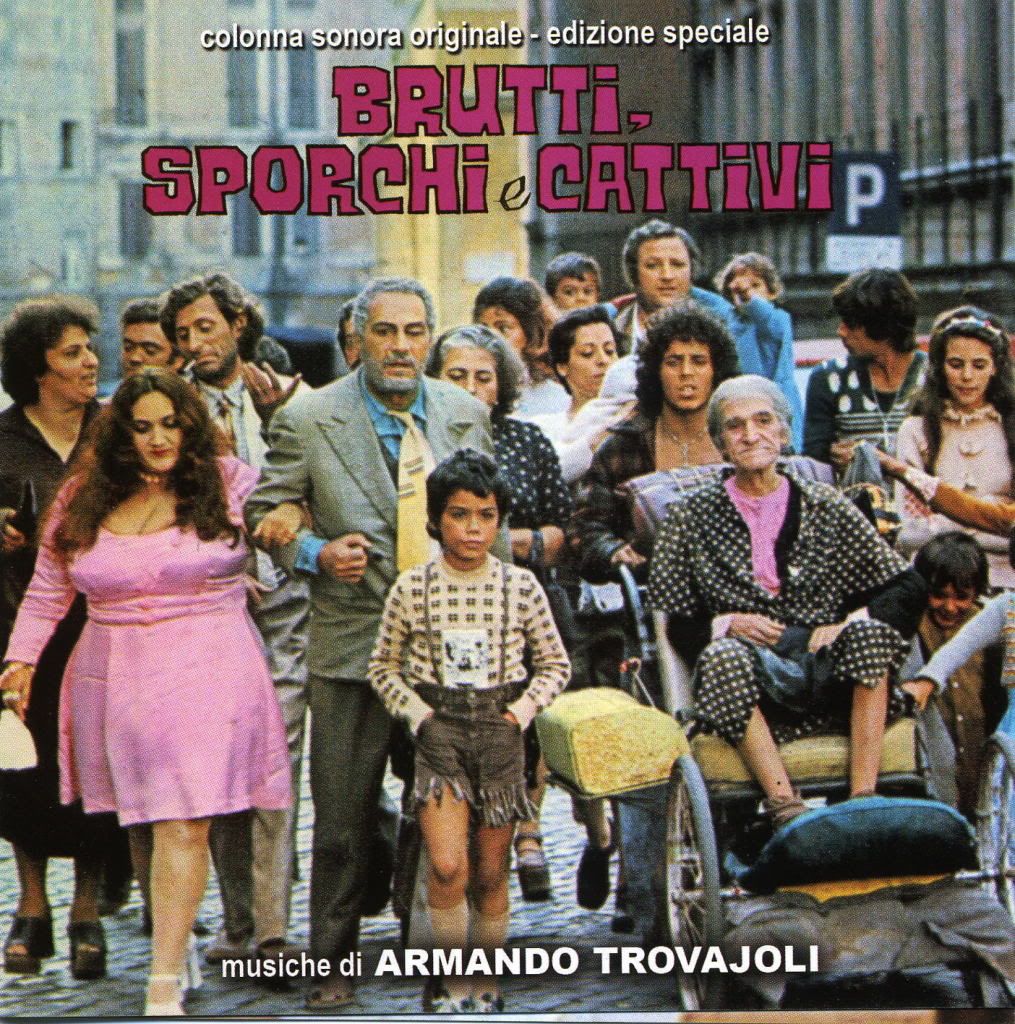
Ettore Scola is widely regarded as one of the most significant figures in Italian cinema. He began his career in the post-neorealist period of the 1960s with the rather uneven film Let’s Talk About Women (1964), an episodic work composed of nine segments whose popularity owed much to Vittorio Gassman’s performance across all of them. In this respect, Scola belongs to a generation of filmmakers who helped shape Italian social comedy—a cinematic form that, unlike neorealism, was marked by a relatively hopeful outlook, closely aligned with the period of postwar reconstruction and the emergence of prosperity and social mobility in Europe.
Scola achieved international recognition with We All Loved Each Other So Much (1974). Yet his most accomplished works, several of which will be discussed here, extend beyond that film to include A Special Day (1977), The Family (1983), and Le Bal (1987). Each of these films adopts a deliberately restrained narrative mode—simple, devoid of spectacular special effects or major formal manipulation—through which Scola constructs what may be described as a form of historical cinematic ethnography, articulated in a fluid and accessible narrative language.
The story of Ugly, Dirty and Bad revolves around its central character, a man who has lost an eye and received a substantial insurance compensation. The film portrays the miserable existence of an extended family living on the outskirts of Rome in an overcrowded and filthy caravan, a space marked by the absence of stable order and shared values. Three generations of the man’s family inhabit this confined environment, all driven by the desire to appropriate the money he has obtained—an objective they ultimately fail to achieve. The protagonist further complicates this fragile domestic economy by bringing a corpulent prostitute into the household, effectively incorporating her into the family structure; she soon aligns herself with the other family members against him.
Ugly, Dirty and Bad, which won the Best Director award at the Cannes Film Festival in 1967, once again exemplifies Scola’s characteristic strategy of using a seemingly simple narrative as a pretext for engaging with the highly contested notion of the so-called “culture of poverty.” Scola’s gaze, as in much of his work, remains neutral—or more precisely, distanced. He refrains from taking a position either for or against his subject matter, seeking instead to remain objective and to avoid explicit moral judgment. Yet it is precisely through this refusal of overt evaluation that the film succeeds in rendering social life visible through the micro-interactions of everyday existence, particularly at moments when shared values appear to have collapsed.
The “ugly, dirty, and bad” figures who populate Scola’s overcrowded caravan—still capable of movement, still in possession of a hidden wealth that could potentially be mobilized to improve their own lives—ultimately emerge as a powerful metaphor for the contemporary world.
This text is an AI-assisted English translation of a note written by Nasser Fakouhi. The original Persian version is available at the link below.
