

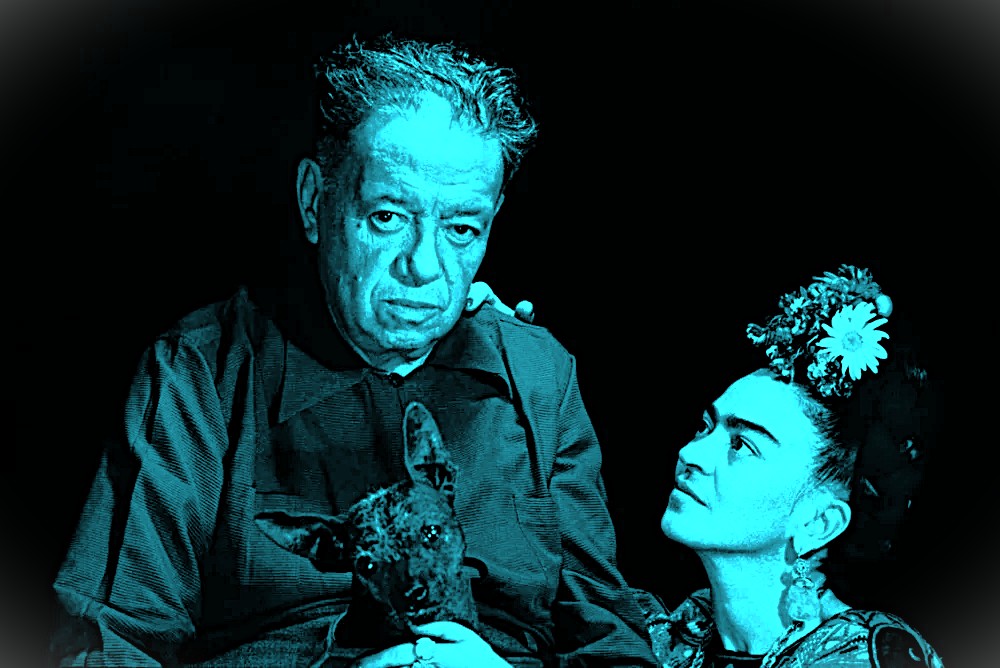
The twentieth century—with all its hopes and anxieties, its creativity and corruption, its illusions and beauty—found not only a moment in time, but also a striking place for its emergence. In Jean-Marie Gustave Le Clézio’s beautiful work “Diego and Frida, we are drawn to seek this moment on the walls of a city that is vibrant and tumultuous, filled with tenderness and beauty, yet at the same time saturated with violence and cruelty. These are the revolutionary walls of Mexico, where a distinctive style of painting was born—a style shaped by great artists such as Diego Rivera, José Clemente Orozco, David Alfaro Siqueiros, and others. This style, muralism, became one of the most significant and socially engaged artistic movements of the twentieth century—deeply rooted in revolutionary fervor and the collective memory of Mexico, and later spreading across the world. It narrates, in bold and passionate strokes, the turbulent history of Mexico and the revolutions that shook the world.
The style of revolutionary Mexican muralists, while bearing surface similarities to other traditions, stands in stark anthropological contrast to the sacred and ecclesiastical painting of the Italian Renaissance—the birthplace of Europe’s new humanism. If, in fourteenth-century Italy, the walls of holy places were opened to painters to depict grand tableaux of saints and divine figures—intended, perhaps, to be eternalized in Christlike glory—then the Mexican muralists sought something entirely different. As Octavio Paz notes in his famous book The Labyrinth of Solitude, these vast urban canvases were reclaimed by muralists to give them back to their rightful owners: the poor, the rural, the people of mixed Indigenous and Spanish heritage, whose only possession was their harsh and painful lives. Thus, the utopianism of the twentieth century began not in industrial capitals but in the impoverished villages of Mexico, in the wake of its revolution, led by figures like Emiliano Zapata and Pancho Villa. Muralists like Diego Rivera, through a lifetime of effort, transformed this utopian vision—however tragic its ultimate fate—into some of the most powerful artworks of the modern era, painting them on the walls of government buildings, neighborhood streets, and the modest corners of a people’s city.
However, to recount the history of the twentieth century at its most passionate moment—the first half of the century—Le Clézio turns to a single life and a pair of individuals who, despite not playing a direct or decisive role in shaping political events, embodied the spirit of the era: Frida Kahlo, the renowned Mexican painter, and her husband Diego Rivera. Though the story is presented as one of mutual love, it is ultimately the tale of Frida’s burning passion for life—a flame that remained lit until her last breath. They were a couple who, on the surface, could not have been more different: Diego, a man unable to resist his affections for other women, married multiple times and seemed to be in love with life itself—a temperament that felt as if it emerged directly from the depths of pre-Columbian Mexican history. And in contrast, Frida, who had only one love in life—Diego. He was her entire world. She famously declared: “Diego is my husband, my son, my father, my mother, my everything.”
Diego, with his enormous and imposing physique, possessed an astonishing physical strength and an almost inhuman capacity for work—sometimes laboring for more than 18 hours a day. His face, described as grotesquely ugly to the point of being terrifying, was often compared to that of a giant toad—an image invoked repeatedly by himself, by Frida, and by others. Opposite him stood Frida: frail and diminutive, with the body of a child. Born with a deformity in one leg, she suffered a devastating accident in her youth that shattered her body. Through countless painful surgeries, she managed to preserve it until her final days. It was a body seemingly built to carry pain—a pain that never left her. Painting was her only refuge against it. Yet despite her physical fragility, Frida possessed a striking beauty: long black hair, deep dark eyes, a unibrow that framed her intense gaze, and a complexion as brown as the native people of Mexico. Her presence was marked by courage, grace, and refinement—a combination so powerful it captivated and even disarmed men of great stature, such as Leon Trotsky, the exiled revolutionary leader, who fell under her spell when he sought refuge in Mexico.
Diego, whose works almost exclusively depicted revolutionaries and the people of his own country and others striving for revolutionary ideals—essentially a form of social painting that narrated history—stood in contrast to Frida, whose art focused primarily on self-portraits. After the devastating bus accident that shattered her body, Frida’s mother built her a large bed with a massive mirror mounted on the ceiling, so that, unable to sit or stand, Frida could continue painting by looking at herself. Later, Frida transformed her own life story and her love for Diego into a universal narrative. She created a painting style that remains profoundly modern to this day and is considered an unparalleled cultural and artistic heritage worldwide. Her art is marked by a brutal honesty in depicting her broken body, unflinchingly revealing the most minute and realistic biological details of her pain, wounds, and even blood spurting like a fountain. Her work deeply inspired leading Surrealist artists and writers, including André Breton, who admired her profoundly and bowed before her genius.
Le Clézio, in this beautifully and simply written book, takes us on a journey from the strange narratives of pre-Columbian Mexico to war-torn Europe, where Diego Rivera was captivated by Paris between the wars and the avant-garde artist neighborhood of Montparnasse (Modigliani, Picasso, Zadkine…). He traces Rivera’s marriage to Frida Kahlo and their travels to North America—Los Angeles and New York—where they sought the future of the world’s working class, as well as their journey to Stalin’s revolutionary Russia, which for Mexican revolutionaries represented a vivid image of powerful socialism. While Diego is a central figure, the true protagonist of the book seems to be Frida, who transforms her body into a painted canvas and depicts her pains in the color of blood. This focus on Frida perhaps reveals a deeper secret: for Le Clézio and many who admire Frida’s passionate life and unique works, she embodies a clear reflection of pre-Columbian America. Her resilience against the pains of life symbolizes the enduring strength of the great pre-Columbian civilization, which despite five centuries of oppression and repression remains alive and vibrant. From this civilization not only emerged a valuable artistic legacy—such as the muralist painting style—but also the rich tradition of Latin American literature.
The Book:
Le Clézio, J.M.G, 2008(1993), Paris : Gallimard
This translation was produced with the assistance of artificial intelligence, based on a note by Naser Fakouhi. The original text can be found at the following link:
