
Andy Warhol (1928-1987) / Campbell’s Soup Cans (1962)
By Nasser Fakouhi

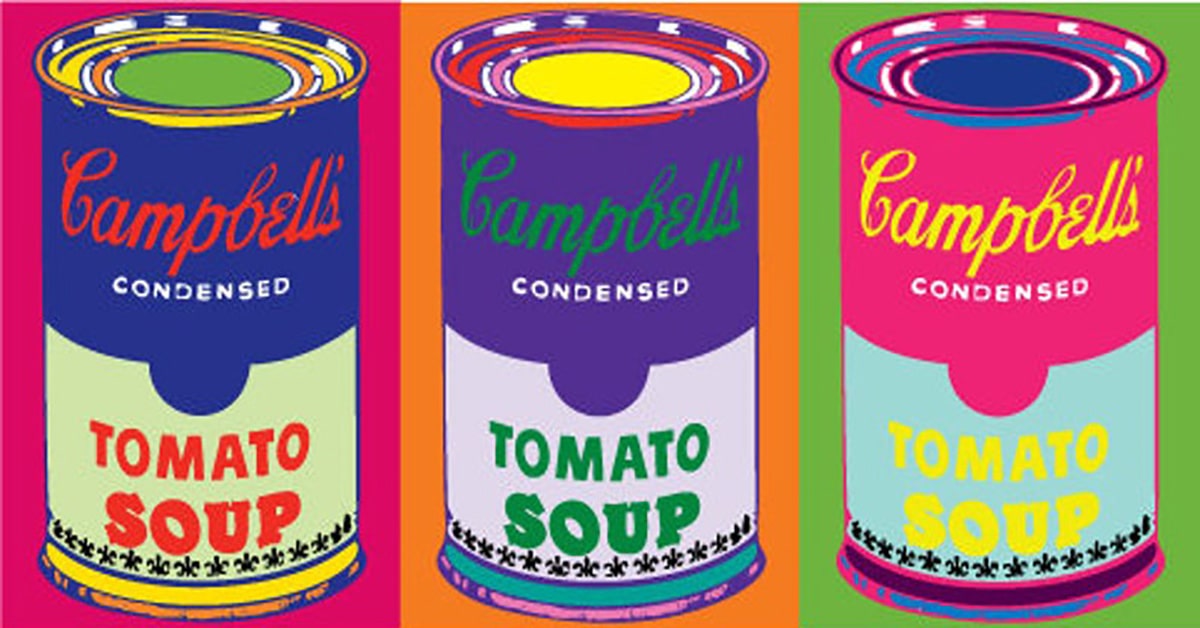
When Andy Warhol’s Campbell’s Soup Cans were first exhibited in 1962, they provoked ridicule and scandal rather than even distant admiration. The display seemed to speak more of a “non-art” than of any legitimate artistic expression. Yet the foundational impact of this work—alongside Roy Lichtenstein’s—on the birth and evolution of Pop Art and the revaluation of the art object eventually vindicated Warhol, with the value of the piece rising from one hundred dollars to tens of millions.Warhol’s soup cans ultimately became a representation of the artist himself—and today, they stand as one of the most iconic works in the history of art. This transformation may be largely due to the remarkable subtlety in Warhol’s arrangement of the 32 canvases (each depicting a different soup variety), perhaps ordered by the year of each soup’s release (according to one hypothesis). The minimal changes in typography on each can also reflect this meticulous attention.
The core message here is that the aesthetic of art resides neither in the essence of the “art object,” nor in the viewer, nor even in the act of contemplation or the interaction between viewer and object. Rather, it lies outside all these realms—in the very reality of repeatability. Soup, in its apparent meaninglessness and symbolic ambiguity, made of largely unidentifiable ingredients, becomes a mysterious, pleasurable, and infinitely repeatable experience. This is the paradox at the heart of Warhol’s aesthetic vision.Just a reality lies in the simple accessibility of the object, the modern—and even postmodern—question remains : Is the art truly in the soup or in the painting ? It’s a question Warhol prefers to leave unanswered. And yet, neither the beauty nor the pleasure of repetition is something that could ever be achieved—or even approached—outside the very “form” of these canvases.
Andy Warhol (1928–۱۹۸۷) / Campbell’s Soup Cans (1962)
This is an AI-assisted English translation of a note by Nasser Fakouhi. The original text is available at the following link :
موزه خیال (۴): اندی وارهول (۱۹۲۸-۱۹۸۷) / قوطی های سوپ (۱۹۶۲)
