
A Different Place, Perhaps a Better Time
On Migration in Late Modernity / Azma Magazine / in conversation with Nasser Fakouhi

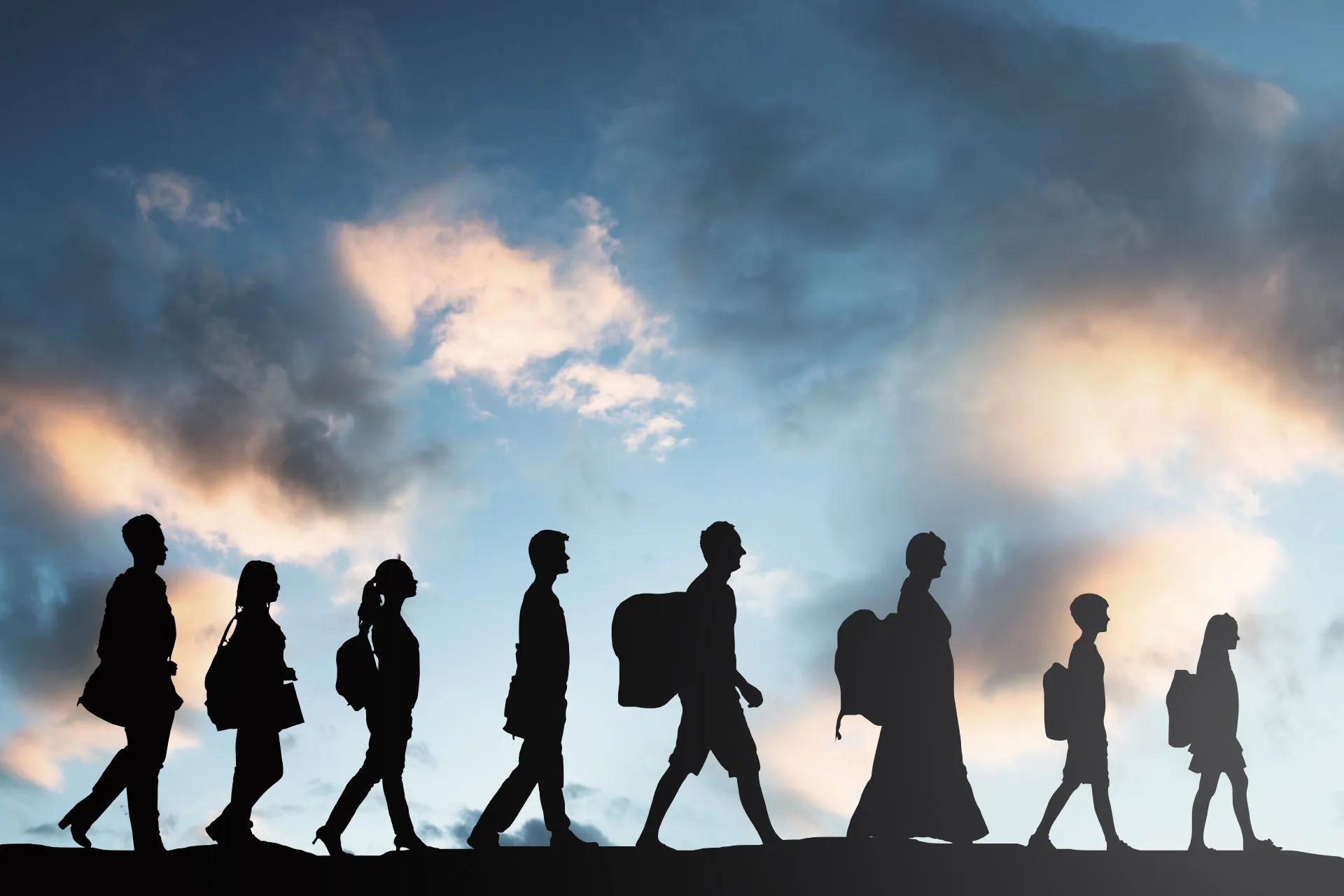
Given the massive waves of migration and brain drain from the Global South to the Global North, alongside shifting climate conditions, do you think the geopolitical geography of the world will change?
Undoubtedly, this will happen. But not solely because of brain drain. First, current migrations are less about brain drain and more a consequence of political and economic disasters. These disasters stem from conditions imposed on the Global South during the 19th and 20th centuries by the central powers (Western Europe and the United States): systematic and exploitative prevention of political and economic independence and the growth of democracy through numerous coups, strengthening anti-intellectual radicalism, religious, racial, and ideological bigotry, and giving free rein to tribal leaders, local tyrants, and later dictators and their Western-educated neoliberal advisors to plunder the people and destroy social organization and management systems—demolishing traditional structures without replacing them with new order. What the West is experiencing today is also a consequence of these destructive policies, which have returned like a boomerang: a situation reminiscent of the period between the two World Wars, marked by both economic and political crises, as well as social tensions and intercultural and racial conflicts that threaten to destabilize and destroy some of the last democratic realms in the world.
To clarify this, consider a few political examples: In America, over the past eight years of Trump and Trumpism, one of the two foundational parties of institutionalized American democracy has been pushed to the brink of destruction or severe damage. The Republican Party today resembles a “cult of personality” akin to the “Moon” sect, and although party elders recognize the danger Trump and his MAGA movement pose to their future, practically, they are powerless against him and his flood of supporters—mostly white, culturally and economically disenfranchised, racist, and radical evangelical Christians. Of course, I do not believe that due to fundamental changes occurring globally—including the factors you mentioned such as climate risks, wars, and dangerous technologies like artificial intelligence and lethal new weapons (intelligence, cyber, atomic, hydrogen, biological, genetic)—any major current actors or even minor dictators in the Global South are prepared to embark on overt military adventures like those of the 1930s and 1940s. However, as both the center and the periphery rapidly move toward anomie, with clear signs including the collapse of conventional political parties and institutions (both governmental and non-governmental, such as trade unions) across the ideological spectrum, and the rise of radical left and right movements incapable of governance, no one can confidently project a future outlook, even relatively.
Western Europe’s conventional political parties are experiencing similar conditions. So far, countries such as Hungary, Poland, the Netherlands, some Scandinavian nations, as well as places like Brazil, recently Argentina, India, Myanmar, Indonesia, and others have witnessed the rise of far-right and radical movements. These circumstances have created vicious cycles that, in the end, can lead only to either a total war or complete social system breakdown and anomie. However, as we mentioned, the West—the center of capitalism and the world’s political and economic power—cannot blame anyone but itself for the current state, brought about by an almost sheer folly that led the Global South into this predicament. What is even more astonishing is that there is no sign of a return from this madness: the recent war in the Middle East, which has pitted the radical and suicidal Palestinian factions on one side against the most right-wing government in Israel’s history—led by a criminal fugitive and including several cabinet ministers convicted in Israeli courts—on the other, has placed the West, despite the heavy price it must pay for supporting Israel and widespread public opposition, firmly on Israel’s side. In the not-so-distant future, the West will pay a severe price for this stance in the form of domestic and international instability within European countries and the United States. The advanced West has reached such an irrational decline that it seems incapable of even the simplest political calculations. Recently (December 2023), the press reported that the government of Pakistan is preparing to extradite Afghan fighters—those who were armed by Britain to fight the Taliban and who remain engaged in the conflict—yet Britain refuses even to offer them asylum. This is the state of the West, which, in today’s world of authoritarianism and chaos, is supposed to represent rationality.
Meanwhile, what you call “brain drain,” which until recently has largely been a reality, will lose much of its meaning in the coming years due to the artificial intelligence revolution. Today, as Yuval Noah Harari puts it, the situation in central countries is such that they must control the “genie they have released from the lamp,” which, if not strictly regulated and limited, could pose a threat to humanity far greater than that of the nuclear bomb. Studies on artificial intelligence have identified only a handful of jobs that will become impossible for AI to perform in the future, most of which are manual and physical labor. Even these jobs—such as plumbing, repairs, and household wiring—are not absolutely impossible for AI to handle, but rather are economically unjustifiable at present. In other words, performing these tasks by humans remains far cheaper than building complex robots to do the same, possibly for decades to come. Therefore, the issue is less about brain drain and more about a general exodus from the Third World to the still somewhat stable Global North. Simultaneously, it involves the flight of the lower classes within this Global North toward the last remaining “bubbles” where individual risks are minimized—such as large cities where parasitic lifestyles and employment are still possible.
Millions of people from China, Russia, the Middle East, and Africa today risk their lives fleeing their countries in hopes of reaching the “safe shores of Europe and America.” However, upon arrival, they often find themselves in conditions similar to the poorest and most marginalized populations of these host countries, all facing the threat of exploitation and destruction by the elite classes. Consequently, they have little choice but to submit to a new form of servitude. Meanwhile, the marginalized groups in these countries—mostly descendants of previous migrants or ethnic and racial minorities—are increasingly joining radical and anti-system movements. Interestingly, rather than predominantly gravitating toward leftist revolutionary factions, many are drawn to far-right and populist discourses. Therefore, while the political geography may not shift as dramatically as some might imagine in terms of redrawing the world map, substantial transformations are likely underway. Signs of this are already visible: the growing divide between the southern and central U.S. states—which tend to be rural, white, Christian, traditionalist, and often racist—and the eastern and western states—which are more urban, ethnically diverse, less Christian, and more educated and technologically advanced. Even if these tensions do not escalate into major conflicts—as seen in recent years through events like the Occupy Wall Street movement, Black Lives Matter protests, and the January 2021 Capitol attack by Trump supporters—they could still significantly intensify the country’s political and social crises, ultimately weakening its global influence over the next fifty years.
In Europe, we face a somewhat similar situation. Take France, for example, where Islam is the second largest religion after Catholicism, with over six million people of Arab descent. At the same time, the prospect of a far-right Christian, racist, anti-Islam, anti-Arab, and anti-immigrant candidate rising to power in the 2027 presidential election is very serious. According to current polls, if the presidential election were held today, Marine Le Pen would likely win. This is why the French right is strongly advocating for a referendum on immigration—a move that the French constitution currently forbids in such matters and would require a difficult but not impossible constitutional amendment. This paints a frightening picture for one of Western Europe’s three major powers. The other two powers, Britain and Germany, are not in a better position. Britain, as mentioned before regarding its political decline, faces a serious threat from separatists in Scotland and Northern Ireland, and internally remains unsettled after its chaotic Brexit. Germany, once seen as a bastion of stability in Europe, has lost the wise leadership of Angela Merkel and—like Scandinavia and the Netherlands, where no one believed a decade ago that far-right movements would take hold—is now at risk of political and democratic collapse, turning into irrational, racist, extremist, and uncontrollable systems.We won’t even discuss the situation in Latin America, Eastern Europe, India, Russia, Southeast Asia, or the Middle East because their crises are so severe that they can be followed easily on daily news pages.
However, the issue is not geopolitical boundaries, but rather the political organization and the new social order that these countries need in order to rationalize both their internal relations and their relations with the Global South. This would enable them to reduce migration and, in some cases, facilitate the return of migrants. At the same time, it would create a genuine possibility for their peoples to understand that globalization and cultural diversity are realities that cannot be denied without sacrificing the democratic system — along with all the associated risks that this entails for everyone, not only migrants or minorities. This risk, in the United States, manifests as fragmentation and a situation reminiscent of the Civil War period (1771–۱۷۷۶), while in Europe, it may lead to a resurgence of fascism, with or without war, and the complete domination of mafia-like autocracy from Russia over the continent.
Given the mixing of cultures, can we consider that the groundwork for a global government is being prepared?
In my view, this is a mere fantasy that cannot be seriously discussed even in the most optimistic scenarios—at least not within the next fifty to one hundred years. Today, most of us are witnessing the dismantling of international integrative institutions. The existing powers across broad regions, which once reached agreements on various matters (such as large labor unions and regional civil organizations), are themselves either on the verge of disintegration or weakening. Therefore, I believe we should expect a global war—albeit a covert or “cold” one—rather than the emergence of a global government. The impossibility of a global government is evident in the current state of the United Nations, which holds virtually no real power, is ignored by virtually everyone, and cannot effectively intervene in issues such as war crimes and genocide in the Middle East. In my opinion, the UN is regressing to a state resembling the period before World War II.
The same can be said about almost all international alliances, except those based on shared political interests—such as the G20, NATO, the World Bank, and the World Trade Organization. These alliances were not established to create a global order for all, but rather to secure the best positions for central countries and maintain the status quo by coordinating among three groups of actors: states, multinational corporations, and powerful mafias. Their aim remains to benefit the elites, competing against emerging powers like India, China, and Brazil, which they fear. Therefore, imagining a global government in such a context of intense internal and external contradictions seems utterly unrealistic. On the contrary, the rise of extreme nationalism, far-right movements, and radical factions on both the left and right appears far more likely, intensifying conflicts. If the world moves toward a global (even if “cold”) war, there is a significant risk that such a conflict could lead to humanity’s destruction or set back progress by several centuries. Yet, even under those circumstances, it is not necessarily expected that a powerful organization capable of initiating a global government would emerge. In short, I have rarely heard or read any thinker or analyst today speak even remotely about the possibility of a global government.
This point should be distinguished from the utopian ideal that most reasonable people hope for—a world where everyone can live in peace, friendship, and abundance. From a material and potential standpoint, this is entirely possible: if humans adopt a more rational lifestyle, the planet could sustain a population many times larger than today’s, with enough resources for everyone to live adequately.
However, where this discussion veers into fantasy is when we forget that it is unlikely—neither overnight, nor within a year or even a century—that humans will abandon their greed, ambition, and competitiveness. These traits are the result of millions of years of conflict, both among themselves and with nature, and they cannot simply be erased from their minds or material behaviors. Therefore, in my view, it is better to focus on more attainable goals: strengthening popular and civil society movements, regional organizations, international cooperation, enhancing the United Nations and its various agencies, and supporting relatively moderate, rational, and justice-seeking politicians. And this applies everywhere and at every level. Wherever we assume that issues can be overturned overnight with a few changes in people, institutions, or regulations, that is precisely where our biggest mistakes begin. In our own country, no matter how many factions have come to power aiming to homogenize people and lifestyles, they have faced opposition and resistance from those who also believe in absolute, black-and-white solutions. Thus, right-wing and left-wing radicalism reflect each other like mirrors, and the outcome for the vast majority is a continuous decline in everyday living conditions and a loss of hope for a better future.
Is the Western theoretical perspective on population growth in northern lands following cultural mixing diverse?
I think your question refers to the differing population growth rates within these countries between immigrant populations and the pre-existing white populations. From a global perspective, populations in the Global South are growing the fastest. Currently, the populations of China, India, Pakistan, the Middle East, and soon (by 2050) Africa will exceed four billion. Africa alone will surpass two and a half billion. There is no doubt that the pressure of such population growth cannot be controlled by the West’s slow, piecemeal immigration policies—and rightly so, because such attempts would disrupt the balance of the world and its cultures. Returning to your question, it is indeed true that the difference in population growth between immigrants and European or American populations is clear. In the U.S., this demographic difference is evident between white Americans and ethnic groups—including Asians, Hispanics, and Black Americans—while in Europe, it appears between white Christian Europeans and Black populations, Arabs, and Muslim or Hindu and Buddhist Asians (such as Turks, Pakistanis, Bangladeshis, Chinese, etc.).The reasons are somewhat clear but differ between Europe and the U.S.: In Europe, immigrant populations tend to have more children than white Christian populations due to their vulnerable status, social support for larger families (usually three or more children), and a traditional preference for sons. In the U.S., the dynamic is influenced by the fear among native populations of whites, who still hold most political and economic power. In both cases, immigrant populations leverage democratic mechanisms—namely, “one person, one vote”—to use their growing numbers to exert more political pressure and claim greater rights. To counter this in the U.S., tactics known as “voter suppression” are employed to limit the voting power of these groups.
For example, in electoral maps—especially in Republican-led states under certain governors—gerrymandering is used to ensure that white voters have greater influence, and that voting is generally easier for them than for Black voters. In densely populated areas, fewer polling stations are set up, which, given that Election Day in the U.S. is not a public holiday, means voters either have to vote by mail (which requires more media and informational resources) or take time off work. White voters typically wait only an hour or two in line, whereas Black or Hispanic voters in crowded areas sometimes wait seven or eight hours, losing pay during that time. Republicans in some of the worst states even passed laws banning giving water or food to people waiting in line (though many of these laws were later overturned). All these measures reflect the fact that for at least two decades, white Christian Republicans have not held the majority of votes nationally. Their strategy to remain in power relies on suppressing votes and insisting on the Electoral College system in presidential elections.
After Trump’s election, white Republican conservatives succeeded in appointing several deeply conservative and corrupt justices to the U.S. Supreme Court. This court overturned a fifty-year-old ruling (Roe v. Wade, 1973), which had protected abortion rights. Today, many states have passed strict anti-abortion laws, some banning abortion after just six weeks—even in cases of rape, incest, or risk to the mother’s life during childbirth. The situation in the U.S. has become so severe that in some hospital emergency rooms, doctors have refused to help pregnant women experiencing bleeding, fearing legal prosecution if the fetus dies. Eventually, intervention by President Biden and executive orders helped ease the crisisThe folly of the American right lies in the fact that this issue has made abortion—and the restoration of women’s fifty-year-old voting rights—one of the most important reasons for voting in the 2024 elections. Over the past four years, Republicans have effectively lost many elections because of this law.Moreover, restricting abortion does not prevent wealthier white women from traveling to other states to terminate unwanted pregnancies or using other methods to control childbirth to advance their careers. As a result, it is effectively the people of color who will continue to have more children. In Europe, the situation is similar. Instead of supporting the professional advancement and social mobility of people of color and non-Christian populations, restrictive laws have been enacted against them. This occurs despite the widening gap between the average living standards in the Global South and the worst conditions in developed countries. Such measures neither effectively curb migration nor encourage people to leave these wealthy countries under pressure. The ultimate result has been the rise of far-right movements across nearly all European countries, promoting anti-immigrant, anti-intellectual, anti-cultural diversity, and nationalist agendas.
How will the concept of homeland be defined in the future, and will such a notion have any place in the world to come at all?
As I mentioned, we can envision three scenarios: a utopian condition, a dystopian one, and a middle path. In the utopian scenario, the distribution of wealth and resources worldwide moves toward balance, reducing disparities among peoples of different countries and increasing cooperation, movement, and communication between them. In this case, while the concept of homeland—as a cultural notion tied to local, national, historical identity, and a shared heritage and destiny—grows stronger, none of these identities conflict with others. People, rather than focusing on migration out of necessity, would think more about domestic and international travel by choice. The dystopian scenario envisions countries turning toward violent nationalism, with increased external wars and internal, regional, and international tensions. Migration would become more difficult, with hidden and illegal forms rising. The situation for migrants and even foreign-born residents in European and American countries would worsen, and existing forms of discrimination—such as denying voting rights even in local elections to non-citizens—could intensify sharply. Fascist or quasi-fascist systems might come to power, harming not only foreigners and non-white groups but also dissenters, sexual and behavioral minorities, and political opponents. This outlook is emerging for the first time since the interwar period in both Europe and America. However, the middle scenario, which I find more likely, is a blend of these two: a continued tension between right-wing white populations on one side and both people of color minorities and progressive white groups on the other. Which of the two previous scenarios will ultimately prevail depends on the dominance of the prevailing political, social, and economic systems within countries and globally: the current competition is between neoliberal capitalism on the right and social democracy or social capitalism on the left. If the first, utopian scenario comes to fruition, the concept of homeland will have a positive, inclusive, and pluralistic meaning. However, in the dystopian scenario, I believe the very notion of war would erase any meaningful concept—even that of homeland—leaving only the ideas of power and social Darwinism in its place.
What changes should we expect due to climate change and the migration of people from southern regions to the north
Contrary to what is often considered a common idea, climate change threatens not only the Global South or the southern regions but poses a global risk. If we follow the news about natural disasters, especially hurricanes and wildfires, we see that European countries and especially the United States constantly face these challenges. Of course, issues like water scarcity, air and soil pollution, and energy shortages mainly threaten southern countries. However, the solutions proposed by the Global North for these problems also create new dangers—for example, the expansion of nuclear energy, which is extremely hazardous. Or the increase in manufacturing solar- or electric-powered devices, which may seem harmless and affordable, directly depends on the poor labor conditions and harsh socio-political situations in the Global South. These conditions themselves drive people to flee from these regions toward the North, perpetuating the cycle of populism, fascism, and the collapse of democracy. Ultimately, this leads to the destruction of democracy and the end of economic prosperity, because neoliberal capitalism practically has no choice but to ally with large multinational corporations and corrupt capital to maintain the status quo. This inevitably results in the acceptance of mafias, and wherever mafias rule, social Darwinism reaches its peak. For example, look at the situation in southern Italy today—despite the country’s overall wealth, from Naples southwards it feels like dealing with a Third World country. In conclusion, climate change directly affects the Global South the most, but in today’s interconnected world, if we do not adopt a planetary perspective—especially in political, economic, and technological spheres—any blow to any part of the world will sooner or later have repercussions elsewhere.
This conversation with Nasser Fakouhi is an AI-generated translation carried out in December and January 2024 (Dey and Bahman 1402 in the Iranian calendar) for Azma Magazine, issue number 179. The original interview is available at the following link:
