
Nowruz Celebration: Myth, Art, and Power
Nasser Fakouhi

Spatial and Temporal Markings
The separation of humans from other biological beings occurred through a long cultural process during which the “world,” understood as a set of human “perceptions,” took shape in the human mind. Among the most fundamental of these perceptions are the concepts of space and time. Humans perceive “objects” and other beings as three-dimensional expanses—volumes—located at specific distances from themselves. Existence, or being, is conceivable in the human mind only through the framework of space. Thus, human perception is inherently spatial in its understanding of external reality—space that gradually acquires more and more meaning through human markings and signification. These spatial markings—starting with the simplest notions such as “up,” “down,” “here,” “there,” “left,” “right,” “north,” “south,” “east,” “west,” and so on—are not only linked to the immediate biological needs and physical capacities of human beings, but also to symbolic representations of external realities within human consciousness. Humans also perceive their existence and the external world through the concept of time. In this context, time refers to a sense of continuity, which is directly connected to the function of memory. That is, at any given moment, memory reconstructs itself along two axes: the past and the future. Time is only intelligible within this continuous flow—within a temporal dimension. The human mind constantly acts as a guide, regulating behavior based on both the quantity and quality of accumulated memory: drawing from past data and projecting into anticipated future actions. In theories of symbolic interactionism, as well as various psychological and sociological behavioral theories, the primary emphasis lies on these actions—actions rooted in memory, or in other words, accumulated time.
In both cases—space and time—beyond their immediate and physical forms, numerous rich symbolic dimensions have emerged throughout the development of human culture and history. These symbols can essentially be understood as spatial/temporal representations of external realities. There exists an extensive philosophical debate regarding the extent to which such representations are internal and innate versus external and acquired—a discussion that dates back to the earliest philosophers. However, what concerns us here is not the proportion of innateness versus acquisition, but rather the symbolic markings made within one of these two domains—namely, time—within the framework of the political sphere, that is, within the processes of formation, accumulation, centralization, distribution, and reproduction of power in human societies.
Spatial signifiers have always maintained a close, specific, and profound relationship with temporal signifiers. The latter have functioned as tools for sustaining memory. From the earliest cave wall paintings of the Paleolithic era, to the creation of small figurines and even tools, all the way to more advanced forms of cultural materialization of space—such as the construction of dwellings, temples, jewelry, coins, and so forth—we witness the embodiment of this relationship. These developments, appearing from the very beginnings of civilization some 5,000 years ago, clearly demonstrate the deep interconnection between spatial and temporal markings.
In the temporal realm, processes of differentiation and symbolic marking can be traced back to the Paleolithic era and to hunter-gatherer communities. These early human groups depended heavily on environmental changes for their survival—such as the timing of animal migration and reproduction, the growth and fertility of roots and plants for gathering, and other seasonal shifts. As a result, they were compelled to constantly seek out signs within nature and their immediate environment.Toward the end of the Paleolithic era, with the melting of ice and the warming of the Earth, humans began to leave caves and spread along the banks of rivers, lakes, and coastlines across the world. With the emergence of agriculture and animal domestication, the human need for spatial-temporal signification grew even more. Modes of subsistence became more advanced and culturally shaped, requiring more structured and regular systems to ensure their continuity.
The Moon and the Sun
From this period—beginning approximately 10,000 to 11,000 years ago—until the emergence of the earliest civilizations in Mesopotamia and Egypt, over a span of more than 5,000 years, humans engaged in extensive spatial and temporal signification of their ecosystems. During this long transitional era, a vast array of myths and belief systems emerged, many of which, in various forms, have endured to the present day.
Temporal signification was, in its earliest forms, directly tied to immediate natural phenomena. The most significant and perceptible of these for the human mind were the changes in the appearance and phases of the Sun and the Moon. As a result, both in mythological narratives and in the sacred texts of major religions, these two celestial bodies hold exceptional power and symbolic status. The Moon and the Sun are not only revered in many religions—regarded as the highest material manifestations of the divine essence—but they also possess clear symbolic and mythological connections to vital aspects of human life in nature, especially with fertility and growth in humans and plants, as well as with purification and the cleansing of human life from impure or demonic forces.
These two natural elements, through their distinct movements, have from the beginning contributed to a vast array of symbolic representations. The Moon, with its gentle cyclical transformation—from crescent to full and back again, evoking a sense of gradual death—and the Sun, with its consistent cycle from sunrise to sunset and rebirth at dawn, have both served as powerful markers of time and vehicles for sanctifying it. Sacred texts have clearly emphasized this symbolic function.
In the Holy Qur’an, for instance, Surah Yunus, verse 5 states: “It is He who made the sun a shining light and the moon a derived light and determined for it phases – that you may know the number of years and account [of time]…”; and in Surah Al-Isra, verse 12: “And We have made the night and day two signs, and We erased the sign of the night and made the sign of the day visible, that you may seek bounty from your Lord and may know the number of years and the account [of time]…”.
Similarly, in Surah Al-An’am, verse 96, stars are also identified as tools for orientation and temporal measurement. In the Old Testament (Genesis 1:14), stars are designated as elements to mark times and seasons, while in the Psalms of David (Psalm 104:19), the Moon and the Sun are credited with governing time.
Thus, soon the Moon and the Sun gave rise to two main types of calendars: the lunar calendar and the solar calendar. Among these, the lunar calendar was primarily religious and ritualistic, especially used in regions without distinct seasons. In contrast, the solar calendar served agricultural, economic, and political purposes, playing a crucial role particularly in countries with well-defined seasons. Nevertheless, in most cultures, the earliest time-marking systems were based on the Moon and its cycles. The closeness or even identity of the words for “moon” (the celestial body) and “month” (a division of the year) — in Persian, English (Moon, Month), and German (der Mond, der Monat) — clearly reflects this deep-rooted connection.
New Year Celebrations
Solar calendars, by marking the large unit of the year, initiate from the beginning a political cycle based on the four seasons. This marking acquires a political character because it can be associated with the concept of renewal, which manifests itself broadly in the idea of “celebration” and more specifically in “New Year celebrations.”
First, it must be emphasized that in political mythology, the emergence of political power is always symbolically represented as a transition from the abyss—i.e., the state of chaos and disorder preceding creation—to cosmic order. This cycle, which in some religions embodies creation ex nihilo, is completed by an eschatological cycle wherein an original ideal state, disrupted by the intervention of a malevolent element (often embodied as a deceptive figure such as the serpent that tempts Adam and Eve), falls into a state of suffering (the fall). This leads to a reign of chaos, or the abyss, and ultimately culminates in a new ideal state.
Festivals essentially serve to affirm and recall three fundamental elements: the origin of humanity (the lost paradise), the identity of humanity (the current world), and the ultimate destiny of humanity (the ideal paradise). Therefore, festivals can be understood as a form of “practice” or “rehearsal” aimed at achieving these future ideals. During festivals, humans are momentarily freed from the pressures and suffering of the fallen state and experience, albeit temporarily, the ideal paradise.
The relationship between festivals and prohibitions such as fasting is clear. Festivals usually emerge following periods of prohibition and signify their end. Prohibition inherently implies lack and absence—that is, closure and captivity—while festivals embody abundance, existence, openness, and freedom. The well-known term “Carnival,” which has also entered our language, derives from the Latin root Carne Levare, meaning “to take away meat,” referring to the celebration marking the end of the Christian fasting period during which meat consumption is forbidden. Many rites of passage—including birth, puberty, marriage, and death—symbolize this transition from a closed to an open state, from contraction to expansion, from constriction to relaxation. The manifestation of this liberation often appears in exaggerated behaviors (excessive eating and drinking) or licentious acts (sexual freedoms) in some cultures. Such practices also justify the use of vivid makeup, masks, and transformations during these festivals.
In any case, the concept of renewal endows certain festivals with a sacred dimension. The English word “holiday” itself originates from “holy day,” emphasizing the sanctity of these celebrations. The sacredness of festivals also carries an anti-demonic meaning: demons are viewed as enemies of joy and merriment, seeking to abolish festivities. Consequently, many festivals—such as the Christian New Year, the Chinese New Year, and the Iranian Chaharshanbe Suri—include rituals aimed at frightening, expelling, and driving away demons. The making of noise and lighting of fires to ward off evil spirits likely dates back to the era of hunter-gatherer societies, before the advent of agriculture.
Beyond their symbolic meaning—where festivals continually renew creation and inspire hope for an ultimate return to the lost paradise—festivals, especially New Year celebrations, also carry political significance. Mircea Eliade, in his studies, provides numerous examples of the alignment between the act of “political founding” and the “creation of the world.” For instance, in Fiji, the ceremony of the king’s enthronement is called the “creation of the world” or “creation of the earth.” In India, this same ceremony, known as Rajasuya, signifies the “renewal of the world.” In Egypt, the enthronement of a new pharaoh symbolized the creation of a new era that emerges after the rupture and collapse of harmony between society and nature.
New Year celebrations represent a form of temporal marking that plays a crucial role in stabilizing collective memory, with this stabilization occurring, in some instances, within the political realm. The year itself is a temporal marker that embodies two types of cycles: first, the natural cycle of the seasons, which attains full significance within agricultural civilizations. The renewal of the world is continuously reflected in the regeneration and fertility of natural beings (plants and animals), so much so that in certain cultures the concept of the year is synonymous with the concept of the “world.” Alongside this natural cycle, there exists a political cycle wherein political power must renew and reaffirm itself during the New Year festival.
In this context, creation is understood as the emergence of political power, establishing a sovereign relationship between the ruler and the ruled. Two types of mythical behaviors can be observed here: obedience and submission, or rebellion and disobedience. In the creation myths of the Judeo-Christian and Islamic traditions, the destructive role of the “deceiver” manifests through acts of disobedience (rebellion = Ṭāghūt), leading to humanity’s fall from the lost paradise to an earthly fate. Thus, within the political myth, obedience is the behavior that consolidates creation, while disobedience results in its destruction. New Year celebrations symbolically and publicly enact the act of obedience. Therefore, these celebrations emphasize two relationships and one form: two relationships, one with the point of creation’s beginning and the other with the point of eschatological culmination; and the form of the New Year festival is a performance that symbolically represents these two relationships as a “symbolic drama.”
Nowruz
The Iranian New Year festival holds a unique spatial significance. This celebration, with a continuity spanning several millennia and surviving through the perilous course of Iranian history, can be understood as a manifestation of the Iranian political idea. This idea has remarkably maintained a cultural continuity within the sphere of Iranian civilization for over three thousand years. It has assimilated numerous cultures within itself and produced admirable syntheses in religious, political, and social domains.
The Iranian calendar apparently shares its origins with the Hindus from the earliest eras, even before the time of Zoroaster. Mary Boyce writes on this subject: “In the pre-Islamic era of Iran, a religious calendar was in use, which apparently dated back to the time of the Indo-Iranians. It seems that the Hindus and Iranians shared a common religious calendar consisting of 360 days, divided into twelve months of thirty days each. This calendar is still used in India by the Brahmins and is called the Svana year because it is regulated by the seasonal pressing of the Soma plant…” It is important to note that the Hindu Soma corresponds almost exactly with the Zoroastrian Haoma, whose pressing was accompanied by the great reward of Ahura Mazda. Vîvahûnt, father of Jamshid (Yam or Yama), was the first human to prepare Haoma, and his reward was the birth of Jamshid—who plays a fundamental role in the mythology of Nowruz.
From ancient times, Iranians were an agricultural civilization that celebrated two major festivals during the spring and autumn equinoxes. The autumn equinox festival was dedicated to the god Mithra and was initially called Mithragan and later Mehrgan, while the spring equinox festival was Nowruz. These two festivals stood alongside the six seasonal festivals known as Yaghānbarān but were distinguished from them and closely connected to each other due to their political significance. The relationship between Nowruz and Mehrgan confirms the cyclical structure of Iranian eschatological political thought. M. Mole considers these two festivals to hold political value as “two mythological stages in the establishment of Iranian kingship.” Nowruz represents the first stage. Jamshid is an ideal king or an archetype of Iranian monarchs. By ascending the throne on Nowruz, he is regarded as the founder of the Iranian political idea. Jamshid’s fall to Aži Dahāka (Zahhāk) results in the loss of Iranian sovereignty, but in the second stage, Fereydun restores that sovereignty once again on the day of Mehrgan.
According to historical evidence, Nowruz originally entered Iran as a spring equinox festival from Mesopotamia. However, in Iran, this festival was reconstructed according to the needs of Iranian political mythology. In this reconstruction, Nowruz is closely connected to two fundamental points in the Iranian mythological cycle: the point of creation and the point of culmination. The agent of this connection is Rapithwin, the lord of the midday sun, and the Ahuraic direction of the south.
We know that Rapithwin symbolizes an ideal primordial and ultimate state. In the Bundahishn, it is written that before Ahriman attacked the world of Ahura, “it was always midday, which is Rapithwin.” The sun’s fixed position at midday is a clear sign of this ideal state, which was disrupted by Ahriman’s invasion and the resulting state of mixture. From that time onward, the sun moves through a daily cycle symbolizing the battle between Ahriman and Ahura. The world at the point of Rapithwin is at the height of Ahura’s dominion. Here, obedience exists in its absolute form. However, as the sun moves away from this point, it begins a gradual progression toward greater mingling with the Ahrimanic state, so that at midnight the world is at the peak of Ahriman’s dominion. At this time, obedience is at its minimum and disobedience at its maximum. Yet, the cycle continues, and from this “time” the Ahuraic forces reassert their dominance over Ahrimanic forces and guide the world back to the state of Rapithwin. This cycle is a succinct symbol of the Mazdean millennial symbolism, representing the transition from a state of absolute separation to a state of mixture, and ultimately the regaining of absolute separation once again.
Rapithwin also serves as the connecting factor between Nowruz and the eschaton. In Mazdean mythology, the eschaton—or humanity’s attainment of an absolute state of separation between the principles of good and evil—occurs through the process of frashkard (renewal and purification) of the world, which carries both natural and political signs. Following the dualistic Mazdean logic, both sets of signs possess positive and negative aspects. The natural signs are manifested in the form of great natural catastrophes that appear at the end of each of the last three millennia of the world’s twelve finite millennia, with devastating floods as their most intense expressions. Alongside these calamities, Rapithwin embodies a natural symbol of the proximity of the eschaton, because each of these three millennia results in an increasingly prolonged stabilization of the sun (fire) at midday. Consequently, this is reflected in the sequential establishment of 10-day, 20-day, and 30-day periods in the three eras of Ushidar, Ushidarmah, and Soshyans, the three promised sons of Zoroaster. These three sons—each born from the seed of Zoroaster hidden in the depths of the lake Kianseh and one of the virgins who bathe in it during Nowruz and Mehregan—will be born, serving as political signs of the eschaton.
Consequently, Nowruz should be understood as a “public rehearsal” of the Day of Judgment. Within the concept of “rehearsal,” two fundamental elements emerge. The first is the performance of the political act, which serves as a prelude to the second element: the political symbolism of obedience. This symbolic obedience is enacted through a specific set of ceremonies and rituals. In the discourse on political performance, the French anthropologist Georges Balandier offers a distinctive perspective. From his viewpoint, the essence of politics lies in power, and power ultimately manifests as a subtle form of a delicate dramatic (performative) game or a universal spectacle of authority. Humans, in their pursuit to acquire and maintain power, continually strive to exploit all available symbols, signs, myths, rituals, and customs to their advantage. Notably, the enactment of roles within this grand political drama often occurs unconsciously, especially in ancient civilizations and cultures. Roles are continuously renewed and reconstructed through a reciprocal interaction shaped by the dominant culture. The stage of performance is a social arena in which certain spaces acquire a particularly high political value. Consequently, just as religious objects and places can be sacralized, a range of objects, locations, behaviors, beliefs, and symbols also take on strong political significance and enter the political drama. Therefore, according to Balandier, whenever we study and analyze a political domain, we must seek to identify and analyze at least one “stage,” a “stage design,” a group of “actors,” and—as in any performance—the “director,” “set designer,” and naturally the “audience.” For this reason, the phrase “the art of politics” does not seem far from logic.
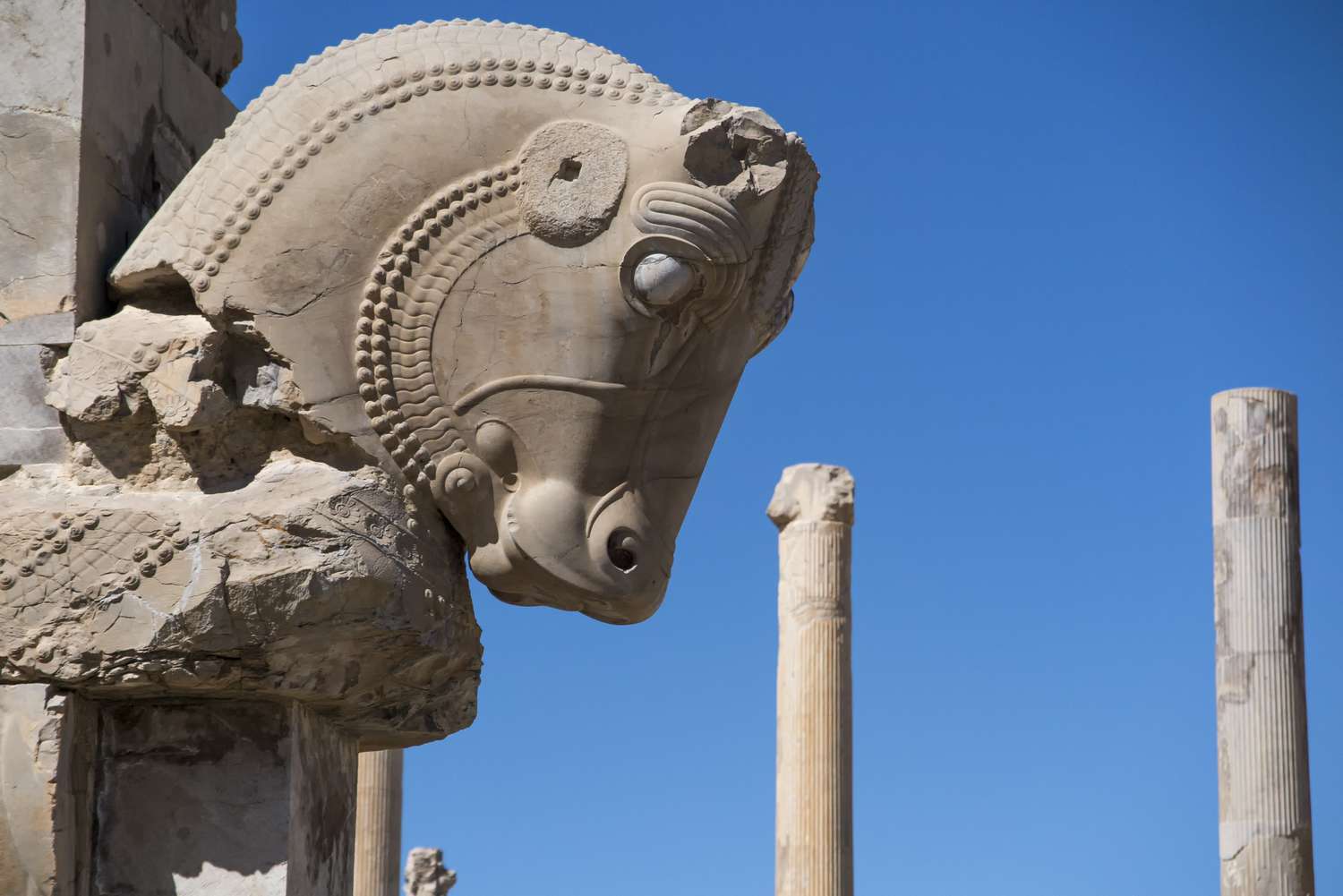
Talking about “art” brings up the issue of “aesthetics,” and thus this concept can carry a heavy load of meaning when applied to the aesthetics of the political realm. In our case, the purpose of “stage design” is to create obedience to a political system centered around the ruler. For the performance to affirm obedience to the ruler—or, metaphorically, to the act of world creation—it must generate a process involving a complex, collective composition of spatial and temporal signifiers. A “performance” requires a decorated stage and actors who reinforce the relationship of sovereignty. The stage for the Nowruz celebration is Persepolis, which transforms this festival into a grand political drama.
John Russell Hinnells, in his book Recognition of Iranian Myths, writes:
“… Persepolis was rarely used, and among its surviving remains, there is little or no evidence to suggest it served as an administrative center. It appears that Persepolis was primarily a ceremonial site—a stage for the annual festival where the peoples of the Achaemenid Empire gathered to pay their tributes and demonstrate their loyalty to the King of Kings. Delegations would ascend a staircase designed to be ridden on horseback, pass through the palace gates and alongside crenellated walls—believed to symbolize the sacred mountain—and enter the Hall of a Hundred Columns. The procession was not merely a display of wealth, but a performance before the fertility god of this land.”
Mary Boyce also finds this explanation quite plausible and writes about Persepolis:
“The various features of the buildings and statues have led some scholars to believe that Persepolis was a sacred city, and that the complex of buildings on the terrace represents a ritual system for the New Year, embodied and made tangible in stone… The entire Persepolis is a lengthy and elaborate prayer inscribed in stone, a kind of Achaemenid vision of the new day and new life preserved in stone as a lasting legacy.”
The actors who step onto this stage are representatives of the general populace and political hierarchy officials, who, in two divisions—Small Norouz or Aam (from the first to the fifth day) and Great Norouz (starting on the sixth day, the Khordad month of Farvardin)—pledge allegiance to the king and, by presenting their gifts, reaffirm obedience to the ruling power and its legitimacy.
It should be emphasized that the consolidation of sovereignty does not necessarily mean the establishment of the reign of a particular monarch. Here, the king or ruler essentially steps onto the stage as the representative of the authority of a system and a political idea. Alexander the Great, the Macedonian conqueror of Achaemenid Iran, despite conquering the country, was never able to lead the Norouz tradition because Iranian clergy, although they accepted his dominion over Iranian lands, never recognized his leadership over Norouz—that is, over the “practice” of creation and culmination, over the Iranian political idea and system. In this context, there is even a hypothesis suggesting that this refusal partly motivated and prepared Alexander to burn Persepolis, although the main reason is commonly seen as retaliation for Xerxes’ burning of Athens.
Nowruz, even in its ancillary rituals outside the political sphere, symbolically enacts the ideas of creation and culmination through the public themes of “renewal” and “purification.” The Haft-Sin table, with its symbolic number seven, represents the seven Amesha Spentas of Zoroastrianism, gathering families around it in concentric circles. This arrangement reinforces the legitimacy of the kinship system based on hierarchical obedience—from the periphery to the center, and from the younger to the elder within the extended family. In doing so, it has helped maintain the cultural-political cohesion necessary for the continuity of society despite enduring hardships and prolonged challenges.
Therefore, Nowruz should be understood as a festival that has always been political and remains so, which is precisely why it can genuinely be considered a manifestation of a “national” celebration. With the advent of Islam in Iran, although the early Arab caliphs initially sought to erase Nowruz due to their racial policies, they quickly realized this was impossible. The Umayyad caliphs, much sooner than expected and primarily for economic reasons, revived the Nowruz ceremonies to collect Nowruz gifts as a form of additional tax. They also transferred the tradition of opening financial records and collecting taxes to this time, as was customary during the Sassanian era. However, before the Jalali calendar was firmly established, neglecting leap years caused numerous difficulties for farmers due to the shifting date of Nowruz. However, with the widespread integration of Iranian cultural elements into the Islamic civilization—initially through the Abbasid dynasty and later through smaller Iranian ruling families—Nowruz quickly reemerged as a powerful political mythological axis embodying Iranian identity. In the synthesis that developed between Islamic religious affiliations and Iranian culture, Nowruz transformed into a festival combining both national and religious elements, forming a central pillar for preserving national identity. Consequently, this festival has become one of the most significant events in the annual calendar of our country and people.
References:
۱. Akoum, A., L’Europe, Mythes et Traditions, Paris, Brepoles, 1990.
۲. Ballandier, G., Le Pouvoir sur Scène, Paris, Balland, Fondements, 1992.
۳. Chevalier, J., Gheerbrant, A., (eds.), Dictionnaire des Symboles, Paris, Robert Laffont, 1988. Coran, trad, et notes par D. Masson, Paris Gallimard, Pleiade, 1980.
۴. Couderc, P., Le Calendrier, Paris, PUF, 1993.
۵. Oxford Study Bible, New York, Oxford University Press, 1992.
۶. Eliade, M., Aspects du Mythe, Paris, Gallimard, 1963.
۷. Eliade, M., Dictinnaire des Religions, Paris, Plon, 1990. pp. 145 ـ
۸. Fredericksen, L., Feasts and Festivals, in, Encyclopaedia Britannica, ed. 1995, vol. 26, pp. 835
۹- Bahar, M. , A Study on Iranian Myths, Tehran: Toos Publishing, 1983 [1362].
۱۰- Bahar, M. , Several Essays on Iranian Culture, Tehran: Fekr-e Rooz Publishing, 1994 [1373].
۱۱- Boyce, M. , History of the Zoroastrian Religion, translated by Homayoun San’ati Zadeh, 3 vols., Tehran: Toos Publishing, 1995–۱۹۹۷ [۱۳۷۴–۷۶].
۱۲- Bundahishn, translated by Mehrdad Bahar, Tehran: Toos Publishing, 1990 [1369].
۱۳- Birshak, A. , Comparative Calendar of Three Thousand Years, Tehran: Scientific and Cultural Publications, 1988 [1367].
۱۴- Pahlavi Narratives, translated by Mahshid Mirfakhraei, Tehran: Institute for Cultural Studies and Research, 1988 [1367].
۱۵- Zarrinkoub, A. , In the Realm of the Eternal, Tehran: Soroush Publishing, 1996 [1375].
۱۶- Fakouhi, N. , “The Endless Cycle of Order and Tension,” in Jame’e Journal, Issues 90–۹۲, June 1998 [1377].
۱۷- Holy Quran, translation, notes, and glossary by Bahā’eddin Khoramshahi, Tehran: Jam & Niloufar Publishing, 1997 [1376], 3rd edition.
۱۸- The Holy Bible, Old and New Testaments, Tehran: Iranian Bible Society, n.d.
۱۹- Mazdapour, K.,“Mythological Foundations of Shahnameh,” in Farhang-e Ketab (Cultural Book), Vol. 7, Fall 1990 [1369], Tehran: Institute for Cultural Studies and Research.
۲۰- Molle, M., Ancient Iran, translated by Zhaleh Amouzegar, Tehran: Toos Publishing, 1993 [1372].
۲۱- Hinnells, J. , Understanding Iranian Myths, translated by Zhaleh Amouzegar and Ahmad Tafazzoli, Tehran: Cheshmeh Publishing, 1989 [1368].
This article is an AI generated translation of the following article by Nasser Fakouhi:
