

The true goal of Iran’s enemies in their aggression war was the weakening and fragmentation of our country. While the issue of weapons and the nuclear program was ans is merely a superficial pretext. In pursuing this agenda, racism, hostility, cruelty, and violence toward immigrants; antagonism toward ethnic minorities and domestic opponents of government policies; suppression of freedoms and intensification of political restrictions; and the promotion of extremist and militaristic rhetoric and actions—all serve as key instruments in the enemy’s post–۱۲-day-war strategy to relaunch an assault on Iran and implement plans for its disintegration.
The twelve-day war that Iran endured—a conflict which, above all, did not inflict severe harm thanks to the country’s cultural strength and civilizational legacy passed down through generations—could very well be repeated for many reasons. There is no doubt that the bravery and resilience of Iran’s defense forces played a crucial role in minimizing the damage. But let us not hesitate for a moment: without the national cohesion and solidarity of the Iranian people—from all beliefs, lifestyles, ethnicities, and Iran’s rich cultural traditions—we could not have emerged with dignity, nor will we be able to withstand future assaults. What has preserved and sustained Iran throughout its millennia-long history has not been aggression or militarism, but rather culture, poetry, art, kindness, hospitality, civility, and civilization. For this reason, our most effective defense—both in the past and in the future (without neglecting the importance of military and political preparedness)—lies in strengthening the very culture of humanity and compassion. It involves rejecting extremist rhetoric, provocative slogans and actions, and instead remaining committed to law and international legal norms. Resorting to racist or ultra-nationalist discourse, which throughout history has led dozens of empires and civilizations to collapse, offers no real protection and only accelerates decline.
Our country faces numerous and deeply complex challenges. Among the most critical reasons are the incompetence of officials, their tendency to neglect essential national issues in favor of trivial ones, and their interference in citizens’ private lives instead of focusing on the infiltration of foreign enemies and spies operating under the guise of revolutionary zeal. The Iranian people are under immense pressure, not only from external adversaries but also from internal mismanagement. Unfortunately, superficial thinking, a lack of awareness, and the deep penetration of hostile forces have created ever-expanding traps designed to bring Iran to its knees. Sanctions profiteers, award-seeking celebrities, opportunists, and power-hungry factions have not hesitated for a moment to propagate extremist rhetoric—whether in the streets or on international platforms—effectively blocking paths toward diplomacy, negotiation, and peaceful solutions. Severing ties with the International Atomic Energy Agency (IAEA), due to its dissemination of inaccurate information and its perceived role in providing pretexts for hostility against Iran—along with the conscious or unconscious transmission of confidential data to adversaries—may be justified. However, it is essential to quickly clarify the outstanding issues and establish binding guarantees to uphold Iran’s legal rights and to ensure that the agency does not serve as an intelligence source for hostile actors. Withdrawing from the NPT, however, would remove Iran from the framework of international law, potentially driving the country into dependency on Eastern powers, increasing its isolation—or both.
A second critical issue is any regression or limitation of citizens’ social and political rights. This would represent another blow to national unity—precisely what foreign adversaries, through their agents of influence, aim to provoke. Finally, increasing pressure on ethnic minorities, political dissenters, or Afghan migrants could again be part of a broader scheme to tarnish Iran’s image and create a pretext for renewed aggression.
Severing ties with the International Atomic Energy Agency (IAEA), due to its dissemination of inaccurate information and its perceived role in providing pretexts for hostility against Iran—along with the conscious or unconscious transmission of confidential data to adversaries—may be justified. However, it is essential to quickly clarify the outstanding issues and establish binding guarantees to uphold Iran’s legal rights and to ensure that the agency does not serve as an intelligence source for hostile actors. Withdrawing from the NPT, however, would remove Iran from the framework of international law, potentially driving the country into dependency on Eastern powers, increasing its isolation—or both.
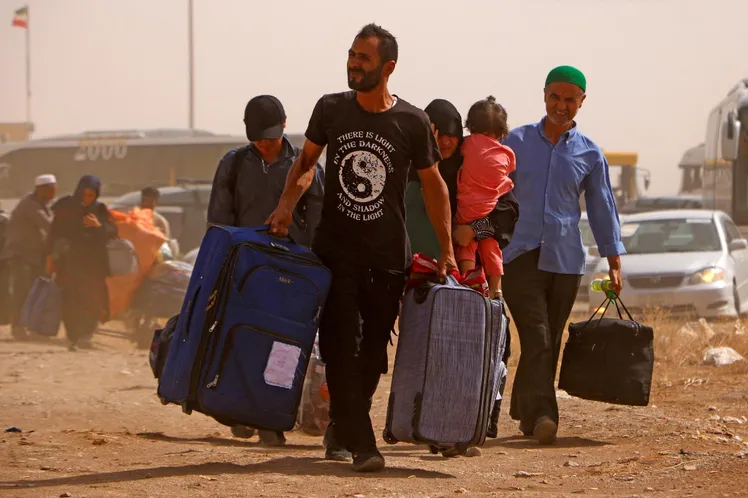
We have repeatedly warned that Afghans in Iran—even those who have lived here for several generations—are subjected to racial discrimination. The rise of anti-ethnic, anti-immigrant, and anti-Afghan sentiments, in our view, fits entirely into a broader strategy of portraying Iran negatively and demonizing the country; similarly, extreme actions and harsh slogans used domestically serve the same purpose. If we are truly looking for enemy infiltrators, we know well that they cannot be found among the Afghan community—who are hardworking brothers, sharing language, culture, and land with Iranians—or among ordinary people who have no access to military or security information. The current emphasis on these issues may itself be intended to keep the real enemies hidden.
For years, Afghans in our country have been used by officials as an excuse to justify every problem, shortage, incompetence, and even espionage and infiltration today. However, it only takes a little reflection to understand that these claims are nothing more than fascist propaganda spread by a group of foolish individuals, profiteers, or real infiltrators. Over the five decades since the revolution, Afghans—who themselves have been victims of the very enemies targeting our country—have sought refuge in their historical homeland, Greater Iran, and the vast majority have lived and continue to live with dignity.
However, the treatment they receive today is inhumane and inconsistent with Iranian culture. Moreover, this mistreatment can and certainly will be exploited against Iran. As we have repeatedly stated, citizens of countries within the historical realm of the Persian language and Iranian culture—who were part of our land until about a century ago—should be able to obtain Iranian citizenship if they wish. This especially applies to Afghans born in Iran or those who have married Iranians. However, right-wing Iranian racists have not ceased their propaganda against this vulnerable yet hardworking minority group, constantly trying to direct blame towards them through fascist rhetoric. It is important to remember that this is precisely what the new fascism in other countries is doing against Iranian immigrants today. Therefore, it is necessary that officials not only stop these actions but also take serious measures against unscrupulous individuals who have plundered the rights (including the assets) of these people. There is no greater dishonor or betrayal than victimizing the vulnerable, and we must be certain that sooner or later, directly or indirectly, our entire nation will bear the cost of this injustice. Afghans, Tajiks, Turkmens, and other peoples of the Caucasus region are an inseparable part of Iranian culture and share with us in the history and destiny of this culture, which unites us all.
Let us not allow the devilish temptation of treacherous nationalists to contaminate and endanger our land: the temptation of vile and dangerous ideas that, sometimes under radical revolutionary slogans and sometimes under radical anti-revolutionary slogans—but both with a single goal—stood firmly alongside our enemies throughout the twelve-day war. Today, they do everything to tighten the political atmosphere, deepen the divide between the people and the government and among themselves, and increase pressure to the maximum, hoping that rebellion, discord, and chaos will engulf the country, enabling them to repeat the scenarios of Libya, Iraq, and Syria in Iran. These groups think of nothing but spreading global isolation, severing Iran’s ties with international institutions, and further blackening Iran’s internal situation—so that widespread attacks against Iran may once again begin. It is precisely for this reason that, even in the current critical conditions, talk of Pan-Iranism, denying cultural rights to ethnic minorities, and the expulsion of Afghans continues.
This is an AI-generated translation of a Persian note by Nasser Fakouhi, the original of which is available at the following link:
۲۷/۰۶/۲۰۲۵
