
Sweet Poplars in the Harmony of Love
Nasser Fakouhi- Sweet Poplars in the Harmony of Love -A reflection on the documentary “The Carpenter Girls: A Duet for a Dream”(2000) by Azadeh Bizargiti

More than this—ah, yes,
Much more than this, one can remain silent.
One can, for endless hours,
With a gaze like that of the dead—still,
Stare into the smoke of a cigarette,
Stare at the shape of a cup,
At a colorless flower upon the carpet,
At a vague line upon the wall… (Forugh Farokhzad)
One can be beautiful—women and girls with graceful, feminine bodies. One can, like so many women in this land steeped in misogyny and patriarchy, come to terms with everything and find solace in the smallest, simplest of things: a warm cup of tea, a melancholic, memory-laden piece of music. One can appear elegant, begin the morning gazing into a clear mirror at that other beautiful self—adorning one’s face and treasuring being seen just as much as seeing.
One can own an intellectual library, filled even with Proust, with philosophical novels and the poetry of foreign writers. Be exceptionally intelligent and defy every cliché people hold about workers. Live in a small town, in a religious family, with a father who left for the war—and still, grow up, move on, live a life. And one can… be a carpenter.
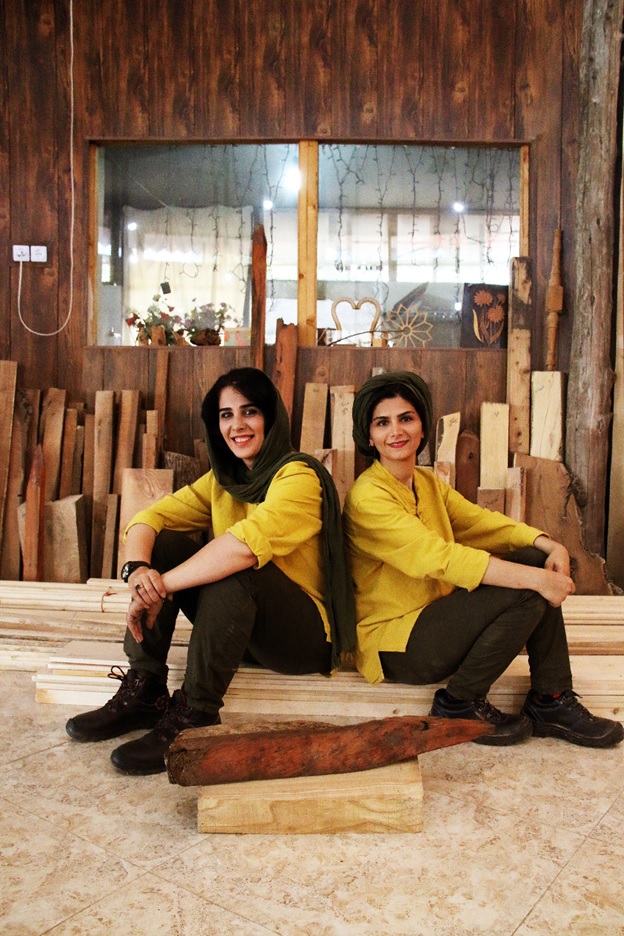
You said: a carpenter? Yes—but carpenters unlike any carved into the clichés of people’s minds. They were carpenters, and like all others, they worked with hard, heavy wood, with sharp and cutting edges, with splinters and sawdust. They owned a shop—one with an unauthorized sign above the door, just like the illegality of your womanhood itself—and they did carpentry. Yet even for that small signboard, it’s impossible to get even a smaller permit, because “you are a woman.”
But really—are you a woman?
You can see the passersby peering into the shop, trying to glimpse “the women” who have abandoned the proper duties of home, of family, of raising the noble sons of society, and instead, have come here—to embrace lifeless planks of wood.
But one cannot be a woman and a carpenter. One cannot take on the masculinity of the wood, the hammering, the burden of heavy labor, the weight of pain—and believe in oneself.
One cannot even find someone willing to lend experience, to extend a hand, to say, this is how it’s done. And yet, one need not remain silent. Even in the most monotonous daily routines of being a “woman” as this society defines it, one can rise into a fervent struggle to infuse life with joy.
One can erase the vocabulary of despair, passivity, and resignation from the mind—and instead, through joy, through action, through a strength perhaps only a woman possesses, overcome the ruthless assault of a society that wishes you silent, withdrawn, defeated, and contained. Even through your gentle smile, the quiet movement of your hands and body, in helping another, in reaching for a hand wearier than yours, in seeing and touching the beauty of nature—you can create singular, life-affirming processes in the vivid current of existence.
They want you imprisoned in the mundane cycle of a “woman’s” life? So that men may carry on with their affairs? Yes, undoubtedly—they do want that. But that very routine, that prescribed dullness, can be turned into a collapse, a rubble falling upon their heads—a harsh yet compassionate warning. A warning not to let themselves become ruthless beings, hollowed-out humans, lost to empathy and tenderness.
One can ride a bicycle, and even stroll through the city at times; step into the marketplace with grace and do the household shopping; even allow others to believe that you’ve accepted the socially prescribed, clichéd role designed for you. One can respond to no protest, just to keep everyone content. One can wander through a city as beautiful as Rasht—a city long considered a cultural gem of Iran—and pause to listen to the melodies of street singers. One can cook, prepare a local dish, brew tea, pull out old family photo albums from the shelves, sigh for a lost childhood, and gently wipe a tear from the corner of one’s eye.
One can move heavy planks of wood, negotiate with customers, and convince them that being a woman is not a “flaw” or “deficiency”—that even if you’re a female carpenter, your mind remains intact, your intellect undiminished.
One can create beautiful objects and, through much insistence, bring men to the realization that it is not gender, but vision and craft, that shapes beauty from the coarse, cold heart of wood. With hands as delicate and graceful as those of any woman, one can give birth to wooden wonders. Like any daughter, one might worry for her mother and family—visit them, recall old memories, even feel a pang of longing for them. At times, she may laugh, at times feel lucky in life, and at other moments, despair over why her womanhood should be such a source of trouble.
One may even come to resent being a woman—despite it being the most wondrous miracle in the world. She may find herself asking: Why must I always explain myself? Why must I justify being a woman? Truly, why am I a woman? Why was it that as Hafez (Iranian great classical poet) himself says, “the sky could not bear the burden of trust,” and “the lot of madness fell to me”? One might ask: why must I, in the silence of swallowed sobs, daily endure the probing gazes of boys yet to become men—men who fear women—who have never before seen a female carpenter?
And yet, one can remain a carpenter still.
One can be hopeful for the future and the present, endure hardships, and find joy in one’s own femininity. One can look upon other women—not with envy, nor from a place of superiority or pity, but purely with friendship and kindness. Day by day, drop by drop, one feels the patriarchal society with flesh and blood, grappling with its worst representatives in bureaucracies, and experiencing a Kafkaesque trial within the labyrinth of government offices: from one room to another, from nowhere to nowhere else, never truly knowing the charge against you, who judges you, or what the punishment might be.
And all you realize is that you must go up and down the stairs, Sisyphus-like, carrying the heavy stone of this society’s prejudices to the mountaintop, only to witness it fall again; then begin your torment anew, for the gods have decreed it so, sentencing you to eternal suffering. You look at society and the world, where all humans are born of women and given life, yet now, to forget the distant but unforgettable helplessness of a small, frightened child cradled in a powerful woman’s arms, they seek to punish all women, telling them they have overstepped their bounds.
One could recite Saedi ( Iranian contemporary Writer) and remain fluent in solitude, yet falter before a crowd—because it is society that stammers, unable to speak of its women without silencing itself. Constantly listening to music, embracing beauty within, she opened her being to the world, caressed the human form of a steaming cup of tea, and allowed the sensation of burning to travel through her fingertips. She felt the fluid motion of life’s flow on her skin and body, warmed by this very heat. She refused to be a vendor of women’s clothing and insisted on carpentry: “Why must it be a man’s job?” Isn’t it enough to remain a mother, wife, sister, and daughter? One can always be among the women who stammer, never able to complete a sentence fluently and without fear of the “other.”
One can be a carpenter. Shed tears within oneself; sit before a canvas and paint all the world’s sorrow with colors soaked in inner grief. Hear the words: because you are a woman, you must not be a carpenter, you must not teach men, you must not laugh out loud, you must not lift your gaze, you must not walk however you please, you must not say whatever you want, you must not see or know everything—and if you do see and know, you must not speak it aloud. Rest assured, each day your list of prohibitions will grow, simply because you are a “woman.” “Are you a woman?” Then every day you must pay heavier penalties just to be granted permission to “exist” — which in the end, they still won’t give you. Each day brings warnings; you clash with male-dominated guilds, with “carpenters” who have never seen a woman near them before. You gaze at a flower’s beauty, listen to the rough voice of a woman reading on a faded page. You lower your head, and all you want is to be recognized as a human, to be seen for your humanity—not asked about your gender; so that because you are a woman, you are not humiliated, not even praised, not even honored, not even offered a gentle smile of kindness.
One can hear every day the voices of men who cannot see any women around them—men who lack the ability to perceive beauty unless they “own” it or crush it beneath their feet. You might come to believe that perhaps you yourself are the real problem. You accept to remain at home, within your solitary, veiled, lifeless, silent, and heavy body—without any sound—forgetting that you are a woman, forgetting your beauty and your love for beauty. You erase from your memory any difference, however small, from other women—just as they have forgotten. You can preemptively accept and follow all the rules, even those yet unwritten, even if you don’t know what to do. You can believe that the strange desires you once had will never return—that you will want nothing at all.
One can sit in the forest; surrounded by trees, surrendering to nature; believing that plants understand the world better than you do and can better endure the mischievous boys who call themselves “men.” One can even tolerate the lamenting words of other women and remain silent; they say: Enough! How long will you keep trying to carry this cursed rock up this tall mountain only to watch it fall again? You sit by the shore, watching the waves, scattering crumbs for the fish, and ask yourself: Why am I not even a fish? You might think that if you were nothing more than a tree, an aquatic creature, or even just water, stone, or wood, it would be easier to bear the words of people who never considered you smart enough to fix a simple stool. You work with all your strength and being for eight years, climbing up and down stairs until you lose yourself. By the sea, with bare feet, you touch the cold sand beneath the foamy waves, feel the coastal breeze caress your skin, watch the distant horizon smile at you, and come to believe that your true place is not where you stand—but in that nowhere land where being a man or a woman no longer matters, and only human existence might hold meaning.
One can grow tired and worn out, witnessing again and again the great boulder’s fall into the valley below. Just as everyone expects, one might sit down and cry; men, after all, love to see women weep because they fear to cry themselves and reveal that they are nothing but frightened boys who have lost their mothers. To cry—something that moves men’s hearts and makes them believe you truly are a woman. To see yourself plundered, your tools stolen—perhaps to prove to you that without your tools, you are just an empty-handed woman, and that the cost of being a woman and breaking the stereotypes you dared to challenge is far greater than you ever imagined. To lower your head, step back into the line, and want nothing more than a breath that comes and goes.
But you are a “woman,” the source of life: despite everything, you can remain strong like ancient, weighty rocks—full of feeling, vibrant, and loving; like the wood you touch, full of warmth and ready to shape your form into pleasing objects to be handled by many: here a table, there a bench, and elsewhere a wooden wall adorned with beautiful flowers. You see people—those with high hands and low hands—laughing and content that you have been broken down. You see the “carpenter girls” worn out: “government, offices, and people—all in their own way.” You heed the officers’ advice and practice “patience.” You have nothing left but bitter smiles with which to comfort yourself.
Perhaps now the conscience of society feels satisfied that women have been sent back home, that their tears have been shed. It is glad that the girls once again look upon the great stone, though this time they doubt whether their shoulders can bear lifting it to the mountain’s peak.
Here, in the rainy North, with rain and the waiting for return, the girls finally decide to climb the mountain once more. But this time, not by way of carpentry, rather by planting pine trees. Though they have not lost their love for carpentry, they did not become carpenters themselves. Instead, they taught the craft of carpentry to other women—an education they had only ever seen in their dreams. Today, for many girls, a dream has turned into reality, so that perhaps in a society drowning in its ancient masculine folly, one day saplings will rise from the ground and know that their fate is to transform wooden bodies, with their delicate, kind, and beautiful hands, into forms embraced by humanity.
A narrative sometimes bitter, sometimes sweet—a compelling story that Bizār Giti, through her film, showed can be told with seriousness and the pride of a “free” woman, addressing the challenges faced by the women and girls of this land. With kindness and smiles that, even when tinged with bitterness, carry the sweetness of life within them. Until the day “Leila and Sedigheh’s duet” becomes the harmony of hundreds and thousands of women and girls, and a better world smiles upon us.
Azadeh Bizargiti’s cinema astonishingly breaks free from clichés: it is dignified and humble, beautiful without embellishment, simple like life itself—like everyday routines, like the endless return to point zero. Her cinema is as clear as the unique aerial shots of Rasht seen in her film; it is alive, vibrant, joyful, and deeply emotional—like the light yet powerful, patient and gentle movement of fingers on the warm, sensitive body of a tea glass, or the intimate embrace of two bodies in the silent, hidden forest. It is a feminine, personal cinema, deeply engaged with the misogynistic and patriarchal world that binds and torments her within society and even within the microcosm of cinematic subcultures. This forces her to see film making as a continuous struggle, embracing all defeats and occasional victories, accepting everything—from sorrows to the unbearable weight of existence—in one whole.
I have seen many of her films and written notes on some. She herself is a “carpenter girl”: a tireless Sisyphus. She has also shone at international festivals. Yet, none of these festivals have ever held value for me. Her worth does not lie in the awards she wins or loses, but in her ability to move beyond one form of cinematic creativity and immerse herself in another with equal beauty and significance—without being preoccupied by prizes. Her camera is like Picasso’s paintbrush: a painter who reached the pinnacle of figurative art at fourteen, and could have remained there for life, yet kept evolving his style until the very end to stay endlessly creative.
Form Search: The issue at hand is this: cleansing the eyes and retelling the old, repetitive story of gender inequality in a fresh narrative, and in a form imbued with meanings and shapes more beautiful than ever—so compellingly that throughout the film, it never lets you divert your gaze from the images. Azadeh is not merely a documentary filmmaker; she is a woman who understands womanhood not only with all its hardships but also with all its joys, creativity, and beauty. When I watch her film, neither the story of the two carpenters matters significantly, nor the misogyny of ignorant men, nor the violence of uneducated officials, nor even the ill will of common people and the well-meaning advice of an old woman who herself has been a victim of a misogynistic society. What makes the film unique is its femininity. I can say with certainty that The Carpenter Girls is one of the most feminine films—in every sense of the word—that I have ever seen.
And perhaps I may add: the most vibrant and life-giving. When the trees entrust their very being to the hands of these girls, and within their unseen wombs are transformed into beautiful objects and reborn anew, a strange feeling envelops the human soul. Like a birth, her film is painful—filled with tears, screams, despair, and sorrow—yet brimming with hope, joy, and other cries that herald life: a child entering the world whose first cries recall the mythical laughter of gods at the dawn of creation. For it shows that it has emerged from the wooden womb of its mother and can now, in the hands of this unique and human mother, become a lasting being; this wooden child begins to walk and gradually starts its life in a perilous world. It visits the homes of people, mingles with them, and ultimately, once again, is embraced by a mother. Only in such a film can one witness how the tools that strike violently, hammer nails, saw, and sand—can be cradled like a newborn, and when thieves come and steal them, tears are shed for their loss.
Only in such a film can one witness women, trees, tools and wooden objects, memories, music, regrets, sorrows and joys, laughter and eyes gazing toward the distant sea, the rain falling upon us, the shadows of trees and the blue sky, hardworking people, streets and bricks, greenery and pools—all of these belonging to the same essence: love and beauty.
September 1, 2021 / Daughters of the Carpenter: A Duet for a Dream, by Azadeh Bizargiti, documentary, Iran, 2020, 75 minutes.
This text was first published in Deylaman magazine, issue 32, November 2021.
This text, inspired by both the structure and the spirit of Forough’s exquisite poem “Another Birth,” was first read by my distant yet ever-present friend, Iranian Filmmaker, Azadeh Bizargiti. She offered thoughtful and insightful suggestions for its refinement. May her mind and soul always remain sharp and lucid, and may her lens forever stay Azadee (Free).
This text is an AI-generated translation of a Persian article originally published on the website of Nasser Fakouhi (nasserfakouhi.com). The original article is accessible at the following link:
